Visar inlägg med etikett knitting. Visa alla inlägg

måndag 11 augusti 2025

Photos from the Medieval Week: Sunday to Tuesday.

 This was my first medival week on Gotland since 2016, when I was over for three days. My last whole medieval week was in 2010. I used to go (almost) every year between 1993 and 2010, and we always camped. And often brought our children. So this was a very different week: The first time I stayed at a B&B, The first time since 2003 (except for those three days in 2016) without children. They are now 30 and 21, so they have their own lives.

I had a marvellous time. I have not yet decided if I miss camping at Visby. I can camp at Double Wars, which doesn't require bringing a car and trailer on a ferry. There is also much less stuff to take care of afterwards. I have washed the linens, spot cleaned or hand washed the wool and silk gowns, cleaned the shoes and greased them. No big tent to dry,

Anyway: Photos!

Sunday: Arrival by plane, and getting to the B&B. Took a walk down to the market, where I met Hans Gunnar from Eikthyrnir , got a nice  beer, and bought some seriously pretty shoes. With a rubber sole attached so I won't slip on the cobblestones and die. Or at least hurt myself.


Wearing my 13th century wool cotte, that I made in 2004. And have worn at practically every camping event since then. 


Look at the pretty fringe that I sewed to the bottom of the new striped gown. And the sexy red shoes. The hose are my very patched linen hose from 2005. Also used A LOT. I might have to make new ones, because they are falling to pieces.

Early bed time, because I had fallen asleep at 1 am that morning, and woken up at 3 am.

Monday: Sara and I went to the market. Which is quite fabulous. Some not so period trinkets and fantasy clothing, but also awesome things like fabrics from Historiska Rum, The Historical Fabric Store, Medeltidsmode, and Korps/Ravencraft. The two former are all about reproduction fabrics, while the two latter are cheaper, and you can still find really good stuff. And reproduction pottery from Krohns Krukmakeri etc etc. There were sellers of plantdyed fabric and yarn, of armour, of musical instruments, of black smith work, and of many other things. And entertainment. This is Arkadia.


I wore the striped gown, and Sara took a photo of me in the botanical garden.

The bwlt is tied high, early 14th century Italian style, and the knitted cap is also Italian from this period. I made a post with both documentation for the style, and a knitting pattern. it is here.

Hollyhocks.

Then Sara and I went to watch what turned out to be one of the absolute highlights of the week: "Sveriges medeltida landskapslagar - the musical". Yes. It is a musical about the Swedish medieval county laws. Yes, it is fabulous. 

* Note: If you for some reason have a need to read the Nordic medieval laws, but don't read the Scandinavian languages, there is a quite new series of scholarly translations published by Routledge. You can probably access them through a university library, at least through ILL. My old supervisor Prof. Thomas Lindkvist did the one on the oldest Swedish one: The Västgöta law.


After dinner made by Sara she had a lie down, and I went swimming in the sea, and for an evening walk.


Tuesday: Tuesday meant mimosa breakfast at Hans Gunnar's market tent. There were lots of us, both from the SCA, and other people. A great time was had.


This was before the market opened, so we could have our orange juice and bubbly bottles on the table.


And afterwards I bought three metres of striped wool from Historiska Rum (link above)  that I have lusted after for months. It might have been the mimosa, but I am happy anyway.


Then I went to a three hour workshop in high medieval music ( I sing, I don't play anything well enough for this) with dr Karin Lagergren and Gustav Näsman Olai , who also plays in the medieval ensemble "Medeltidsbandet Själ". It was so much fun. I really miss singing medieval and renaissance music. Of course the workshop was held in a medieval building.


Then we had dinner, and it was evening, and I went swimming and walking again. It was windy and fun waves.


Here I am wearing my handspun, handwoven cotton dress. It ought to be a half linen/half cotton weave, but I couldn't get both that and handspun and hand woven. It is an Italian style from c 1300, where half cottons was used a lot for lower class clothing. You can read about the dress here. Because, if you didn't know this already: I rarely make anything without documenting the shit out of it.


Wednesday and Thursday will be the next post.

onsdag 16 februari 2022

Knitting a 14th century Acorn cap

By Mesterinne Aleydis van Vilvoorde/Eva Andersson

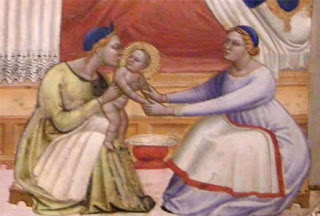
This cap is inspired by 14th century Italian art, where you sometimes see both women and men wearing small skull caps. One example, shown below is the Birth of the Virgin by the Master of the Ashmolean Predella c 1365-137


Photos by user Sailko on Wikimedia Commons, reproduced according to the Creative Commons terms (CC BY_SA3.0)  

You can see a much better quality image on the Ashmolean web site.

While we do not know if these caps were sewn from fabric, felted, knit, or made by some other technique like sprang, knitting is a plausible interpretation; given both how they look, and the fact that guilds for knitters of caps and gloves were present in many European countries in the 14th century ( Turnau, Irena, History of knitting before mass production, Akcent, Warszawa, 1991, pp 20-23)


Yarn and needles

I used 2 play sport weight wool yarn from Kampes (300 m/100 grams or 328 yd/3.53 ounces), a Swedish spinnery, but any non superwash wool yarn can of course be used. Since it is important that you will be able to felt it a little, superwash will not work. There are yarns specially made for felting, but I used what I had at home. Felting will shrink the cap, depending on how much you felt it.

I used a 2,5 mm (US 1 ½) cable needle, and when the decreases made the cable needle too large, 2,5 mm double pointed needles. Magic loop is of course also an option, in which case you won’t need the DPNs except for the I-cord in the end. 


Pattern

Cast on 136 stitches

Join, mark the start of the row with a marker, and knit until the cap has a height of 6 cm.

Next row:

Knit 15 stitches, knit two together, repeat until the end of the row

Knit 3 rows

Knit 7 stitches, knit two together, knit 14 stitches, knit two together, repeat, ending with knit 7 at the end of the row.

Knit 3 rows

Knit 13 stitches, knit two together, repeat until the end of the row

Knit 3 rows

Knit 6 stitches, knit two together, knit 12 stitches, knit two together, repeat, ending with knit 6 at the end of the row.

Knit 2 rows

Knit 11 stitches, knit two together, repeat until the end of the row

Knit 2 rows

Knit 5 stitches, knit two together, knit 10 stitches, knit two together, repeat, ending with knit 5 at the end of the row.

Knit 1 row

Knit 9 stitches, knit two together, repeat until the end of the row

Knit 1 row

Knit 4 stitches, knit two together, knit 8 stitches, knit two together, repeat, ending with knit 4 at the end of the row.

Knit 7 stitches, knit two together, repeat until the end of the row

Knit 1 row

Knit 3 stitches, knit two together, knit 6 stitches, knit two together, repeat, ending with knit 3 at the end of the row.

Knit 1 row

Knit 5 stitches, knit two together, repeat until the end of the row

Knit 1 row

Knit 2 stitches, knit two together, repeat until the end of the row

Knit 1 row

Knit 2 stitches, knit two together, repeat until the end of the row

Knit 1 row

Knit 2 stitches, knit two together, repeat until the end of the row

Knit 1 row

Knit 1 stitch, knit two together, repeat until the end of the row

Knit 1 row

Knit two together, repeat until the end of the row

Knit 1 row

Knit 1 stitch, knit two together, repeat until the end of the row = 4 stitches


Move the 4 stitches to one DPN, make an I-cord c. 2-3 cm long.

Making the I-cord

Knit all stitches.

Slide the stitches back to the beginning of the DPN.

Bring your yarn around the back and start knitting again. Make sure to pull the first stitch tightly, drawing the loop closed.

Cast off and weave in the ends with a darning needle.


If you sometimes end up with extra stitches by the end of a row, just keep going, it will probably end up right in the end, otherwise just make a decrease during one of the knit rows and it will all work out.


This is how my cap looked just off the needles.


Felting and shaping

Fill a basin with hot water with soap (I use såpa, a liquid Swedish soap) an put the cap in it. Let the cap soak up the water and pull it to even the tension of the stitches.

I use my feet to felt the cap, but you can also use your hands of course – kneading and rubbing the knit fabric to make the wool fibres lock together. You can also wash the cap in the machine, but then you, of course, have much less control of the felting process.

When you have felted the cap as much as you like, you shape it - I used an upturned bowl that I let it dry over.


torsdag 13 juni 2019

A new 16th century knitting project

As you might have seen I have made several flat caps from the Gagiana pattern that Marion McNealy constructed  based on a preserved flat cap from the 1583 Italian shipwreck of the same name.

Two of them


I also used the same pattern as starting point for one of those 17th century knitted tall hats that they have found in Denmark.


Photo by me, from the National museum in Copenhagen

That one wasn't a perfect success, so if I make another one I will make some adaptations to the pattern.

But, happy as I am with the Gagiana pattern - it is easy to follow and makes excellent flat caps - I have now had the opportunity to have closer looks at preserved flat caps at the Germanisches Nationalmuseum, plus photos from other museum collections and I have come to the conclusion that at least most of them are made from thinner yarn than worsted. I also want to make a split overlapping brim. I know that there are patterns for that which you can buy, but I'm cheap too ;)  So I may have to make my own pattern (how hard can it be? Famous last words). I am making it for Sir Måns, because my husband doesn't wear 16th century.

I was thinking about using fingering weight, but then I fell in love with this sport weight yarn.  It is from a local spinning mill, and really nice to work with. 

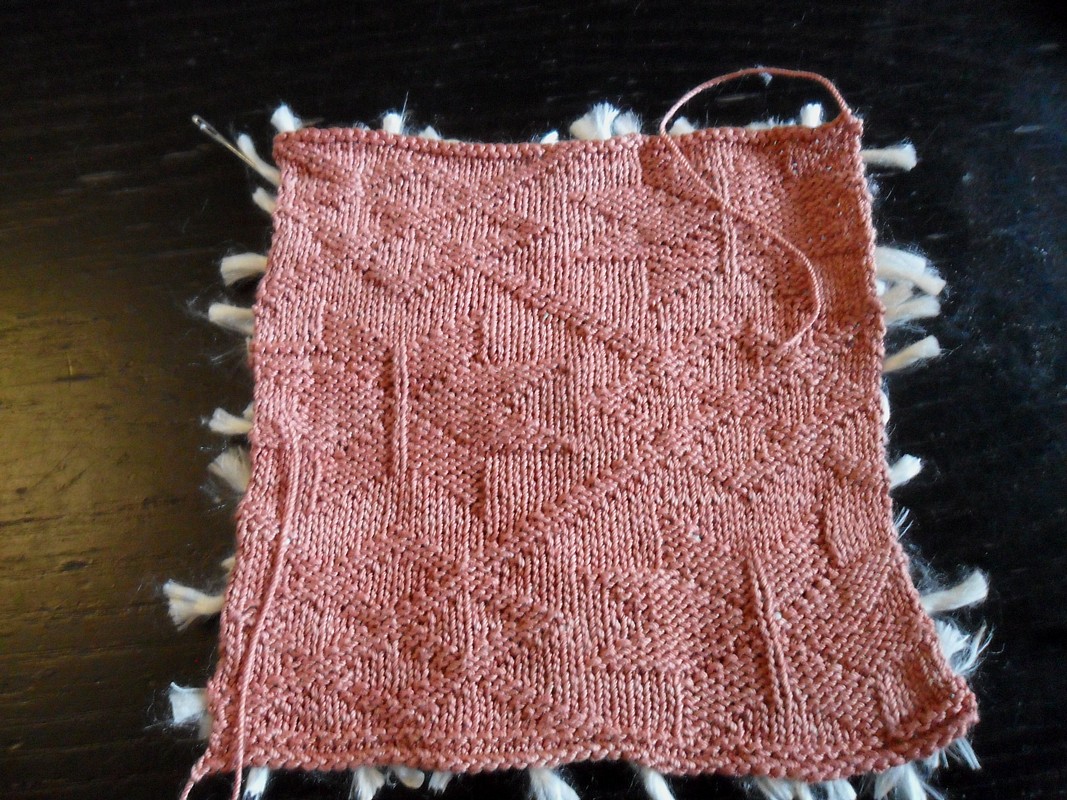
I started with knitting a swatch, which will later be hand (or foot) fulled). it is 35 stitches and 25 rows on (from bottom) 3 mm, 2,5 and 2 mm needles. I'm sort of hoping that the 2,5 mm will be fine enough.


Now I will measure the swatch before felting. "Now" as in when I have worked some more on an article for The Journal of Dress history.

söndag 17 februari 2019

Sir Måns' 16th century shirt

I have been very busy knitting my husband's 50 years' present, without him noticing, so there hasn't been much historical sewing lately. I made a 1940s dress for work two weeks ago - and I finished Sir Måns 16th century shirt. That it took so long for it to be finished wasn't my fault really, the embroidered cuffs and collar were, as you may remember,  finished in August, but I didn't have enough fabric for the body until January this year. As soon as he brought it to me, hand sewing the shirt was a piece of cake.

Bascially I'm using this pattern, based on the Warwick shirt (scroll down), which I have used since the early 2000s, though taken from a now dead site.

Anyway, here it is


Close-up of the collar and cuffs, while cosntructed:


And, for good measure, my husband's sweater:


tisdag 21 mars 2017

A knitted barrett/flat cap

On Friday I started on a knitted flatcap/barrett. I used Marion McNealy's (yes, that Marion McNealy, of "Drei Schnittbücher" fame) pattern based on an Italian barrett from the wreck of the ship Gagiana.The pattern can be found on her web site for free!

It's very simple, and a quick knit. Since I was at an event most of the weekend I couldn't knit as much as I would have done at home (there was, after all, court to plan, and to hold :) ). And still I finished it Yesterday.

I used a worsted weight yarn bought cheaply at a supermarket some years ago and 4,5 mm needles (US #7). The barrett was fulled in the washing machine on 60 degrees Celsius.

Selfie:


And, because I think it's funny, A photo of how little it takes to make you look period if you crop the photo so that only the head and neck is visible:


måndag 2 maj 2016

16th century mittens for Maja

Double Wars has already started, but due to my work we can't go until Wednesday afternoon. I wasn't going to make anything new (I've made enough new garments already), but then I remembered how could the evenings can get this early in May.
So I decided to kill two birds with one stone: I am teaching a class about knitted garments in the renaissance and it's always good to have examples for people to see and touch.

2014 I made a pair of mittens for Maja based on a find from the 16th century, now in the Museum of London:


It is part of a set of clothing for a small child, much smaller than Maja of course.


These are the ones I made in 2014, from alpaca yarn that I had got from my friend Anna. It was part of the Historical Sew Fortnightly. Alpaca yarn of course isn't period, but like many kids Maja is extremely sensitive about teh scratchiness of wool (personally I love the feel of wool to the skin) and in combination with the fact that the yarn was free and I would use up a remnant that otherwise would just lie there in her stash made it an easy choice.


Maja used them a lot, which probably is the reason why they are now lost. They would also have been too small for her now, even if we had known where they are.

So yesterday I started on a new pair, also yellow, and also made from yarn that I had got from Anna. And, again not period: it's a mix of cashmere and merino. Very soft and perfect for kids.


It's a good thing that mittens are so quick to make, even if you have to unravel a couple of centimetres as I had to. I count on the other one being finished by the time we leave for Double Wars on Wednesday, even if I have lots of work to do.

The pattern is improvised as I knit, but I am thinking about actually writing it down.

torsdag 7 april 2016

Test knitting

So, at Double Wars I am going to give a class on renaissance knitted garments:  waistcoats, sleeves, stockings, hats and mittens. I am of course going to bring my knit silk Eleonora di Toledo stockings, but I thought that it might be a good idea to bring some samples to let people see and feel how these garments may have looked and felt to wear.

My first sample is damask knitted silk with a knotted in silk pile. This technique was used in waistcoats and sleeves in the Nordic countries in the 17th century, which is too late for teh SCA of course. Knit wool sleeves and knit silk waistcoats are, however, known from many European countries from the 16th century. So, even if none of this particular type are preserved, I thought it worth trying the technique and showing the result. I was naturally especially tempted by the fact that we have one of the preserved 17th century ones a our local museum and I have had the joy of examining it closely.

Most preserved knit silk waistcoats are from the 17th century, there are a few that could be dated earlier - if you want a lot of links to extant ones, you should have a look at this blog post.

Anyway, the yarn here is a little thicker than silk buttonhole twist, it also has a tighter twist. The originals generally had a looser twist, but I was working with what I had at home, more samples will be made later.
   I am using 1mm/US #00000 needles. They're carbon fibre, from KnitPro. I wish I had longer, steel ones though.


The dots on my kitchen table cloth are 12,5 mm/ 1/2 inch wide, so you get some size comparison.


Maj Ringgard has made the most recent analysis of the 17th century damask knitted silk waistcoats in her article  “Silk Knitted Waistcoats - a 17th-century fashion item” in Mathiassen, Tove Engelhardt, Nosch, Marie-louise, Ringgaard, Maj, Toftegaard, Kirsten & Venborg Pedersen, Mikkel (ed.), Fashionable encounters: perspectives and trends in textile and dress in the early modern Nordic world, Oxbow Books, Oxford, 2014. She found that of the damask knitted waistcoats those who were knitted in the round, which were the majority, had the silk pile knotted in afterwards, while those knitted in the flat had the pile knitted in.
   This sample is obviously knitted in the flat, but I decided to knot the pile anyway, for this sample.


Unlike the originals I used a different coloured, much looser twisted silk yarn for the pile. This was due to the fact that the salmon coloured yarn is to tightly twisted to give the soft pile you see in the preserved ones. At the same time the while silk yarn is both way too thick and too loosely twisted for the knitting.
Having seen the knit waistcoat at Gothenburg City Museum up close I am not sure if it was the same yarn used for the knitting as for the pile, though it definitely was of the same colour. More testing will be done.

Anyway, this is how it looks when finished, from the inside and from the outside.


And it feels absolutely lovely on the skin. This was ptobably not an issue in period though, since you would have been wearing a shift or shirt under it.

It is unlikely that I will ever knit a whole waistcoat, it is boring and slow work to knit on so small needles, but I will look into the 16th century sleeves more and may make a pair from wool when I start makign 16th century clothes again - the coming years I will be concentrating on the 13th-early 14th century, as you might know.

onsdag 13 januari 2016

My 16th century silk stockings are finished!

Photo proof.
Posing in a smock and on a piee of fabric that eventually will become part of a 15th century Italian gown.


They were started in July 2015 (you can read more about the pattern I used etc, if you follow the link), but I have made so many other things since then that it took a while to finish them.
Which, naturally, led to them being slightly different in the foot, since i had forgot exactly how I did last time. But since I plan to wear shoes with them that shouldn't matter much. And also, with such fine thread it is hard to make out the stiches unless you look really closely.

Pattern by Anne des Moines.