fredag 26 juni 2015

I've finished the embroidery on my new 12th century wool gown

As you can read about on its own page the embroidery on this gown was made after the dress was worn the first time on Double Wars in May, and it's taken a while, but now it is finished.
And pretty, in a German 12th century style.


fredag 19 juni 2015

Midsummer and my folk costume

Since it's Midsummer's Eve, which is one of the main holidays here in Sweden and an occasion when those who have folk costumes tend to wear them I thought that it was about time that I moved over the info about my folk costume from my old web page and gave it its own page here.

After I had been to a park with my youngest to dance around the midsummer pole of course. In my folk costume.


The dance group Göteborgs National Dans Sällskap, showing other costumes and traditional dances. Though mostly without proper headwear.


tisdag 16 juni 2015

The knitting insanity has begun

After reading up about 17th century knitted silk waistcoats/nightshirts I was rather tempted to make one. Well, until I had a closer look at the one in our museum, which I wrote about in another post. I didn't mind knitting with thin yarn, but almost sewing silk thin and a whole waistcoat is just out of the question. I am not that mad.

That I am more than a little mad is, however, without doubt, because I have just started on my second set of Eleonora do Toledo's stockings.

If you're not familiar with them, they're from Eleonora' di Toledo's grave and s such from before 1562. They were made from (originally) crimson silk in a pattern made up with alternating knit and purl.


I am not making the pattern myself, but am using a reconstructed pattern made by Anne Des Moines, which can be found for free here.

Since I haven't done any knitting in silk yarn before, and we're talking lace weight here, before I made a trial version last year from a fingering wight silk/alpaca mix. Of course it doesn't behave exactly the same, though alpaca also is less elastic than wool. But I wanted to try the pattern before I started in silk.

This is the result. They're knitted on 2mm/US #0 needles from DROPS silk/alpaca.


I'm rather fond of knitting stockings and it actually went quite fast. The pattern was good and easy to follow. It has a ribbed section added, to make them stay up, but I skipped that and keep them up with garters like they would have been in period.

The problem was to find good silk yarn, but last week I found and ordered silk from a woman who actually lives in the same town as I do. She is closing down her shop and has fewer clours than she used to, so instead of crimson I ended up with burgundy. The yarn is about the same thickness as buttonhole silk, but with a looser twist.
I made a swatch on the train up to a conference this Friday and settled for 1,5 mm /US #000 needles. So yesterday I started and this is how far I've gotten. They will take a lot of Harry Potter audio books to finish.


måndag 15 juni 2015

Matthäus Schwartz Trachtenbuch

Okay, maybe all of you already knew this, but I didn't know that you could download the whole Matthäus Schwarts Trachtenbuch as a PDF. You find the link from the Wikimedia Commons page.

Dr Ulinka Rublack at Cambridge University, who is one of my favourite scholars on dress in Early modern Europe has not only written about Matthäus Schwarz in her book Dressing Up: Cultural Identity in Renaissance Europe (Oxford, 2011), but also worked on a project with theatre costumer Jenny Tirimani to recreate one of the costumes. Here you can see a video clip about it - it's amazing.


There's more info about Matthäus Schwartz and the project here.

Matthäus Schwarz, 22 years old:


onsdag 10 juni 2015

Cotton velvet. 34 metres of it.

I know - they didn't use cotton velvet in most of the periods I make costumes from. But while it doesn't feel like period velvet - I have patted a 15th cnetury silk velvet cope, it was soft as a kitten's belly - it looks much like it and for me that is the most important thing.
   This velvet is short napped, as the period velvet I have had the fortune to examine, but not as densely woven as the one from the 15th century that I patted, but we shouldn't forget that napped fabric came in many different qualities also in period (and with different names), so I think this one will do nicely. I can't afford silk velvet, and besides: the ones I've seen tend to be limper and more slippery than period examples.

This, on the other hand was a bargain. I found it on Tradera, which is a Swedish auction site, like eBay. Since they didn't ship, but you had to pick it up the competition wasn't that great and I got it for 415 SEK /c. 45 euros or 50 dollars). Add a couple of hundred SEK for the car pool fee and the gas and it's still very cheap. And we got a nice road trip which included a walk by the sea in the sunshine.


It is technically vintage, since it's from before the unification of Germany (the label says "West Germany"), but given my age I don't like much thinking of the 1980s as vintage ;)

I don't know what to make from it yet, except that I plan to make a gown to wear with this short cloak, as a part of my long term project to make more clothinmg that could have been worn in Sweden in period.

fredag 29 maj 2015

17th century job perks

Yesterday I was at the Gothenburg Historical Museum's storehouse to look at some 17th century textile artifacts. I am currently working on a project together with the museum, where I put some of their objects into a larger context; using contemporay art and written sources.

I of course knew that these existed, but it is really cool to see them up close.

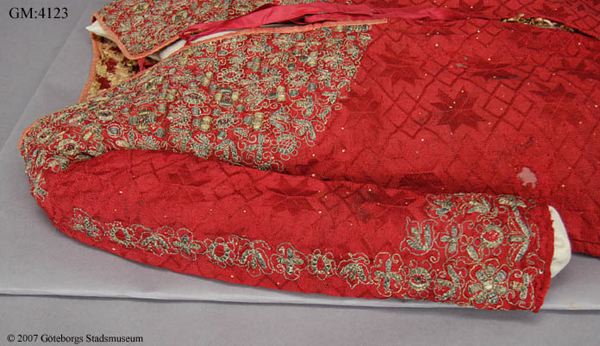
This is a silk knit waistcoat from the 17th century.


All photos of the knitted waistcoat by Klas Blomgren. Rights to the photos belong to Göteborgs Stadsmuseum, but they can be used for non-commercial use. See the catalog web page for terms and for more photos.

This type of waistcoat is called "damask-knitted waistcoats" and there are 14 known exmaples from the 17th century: One in England, one in Scotland, 11 in Norway and one in Sweden; this one. Maj Ringgard has recently written an article on them:  “Silk Knitted Waistcoats - a 17th-century fashion item” in Mathiassen, Tove Engelhardt, Nosch, Marie-louise, Ringgaard, Maj, Toftegaard, Kirsten & Venborg Pedersen, Mikkel (ed.), Fashionable encounters: perspectives and trends in textile and dress in the early modern Nordic world, Oxbow Books, Oxford, 2014
While the brocade knitted type of waistcoat appear to be Italian in origin, Ringgard argues that this type was, if not made in the Nordic countries, at least made for this market. At least we know that they were imported - Swedish customs lists from 1685 show that 436 knitted silk waistcoats and 84 wool knitted waistcoats were imported in that year (Hazelius-Berg, Gunnel, “Stickad tröja” i Fataburen: Nordiska museets och Skansens årsbok. 1941, Nordiska museet, Stockholm, 1941), and they are also found in shop inventories from the period.

They were made with a silk pile on the inside to provide extra warmth.


The yarn used is somewhere between sewing silk and buttonhole silk in thickness.

I also got to look at some less luxurious garments, equally interesting. 

This is the front panel of a wool jacket with a striped wool lining, which was found in 17th century layers during excavations in Gothenburg. The original colours are impossible to make out, but at least you can see the stripes. Here's that garment's catalog page. The photos are taken by Anna Adrian and the rights belong to Göteborgs Stadsmuseum.


I saw other cool stuff too of course, like these remnants of a 16th century leather jerkin which were found during excavations in the 1910s, and the remnants of a pair of 17th century shoes and gloves.


tisdag 26 maj 2015

The 19th century and me

I never really got into making 19th century clothes. I think they're beautiful, but since I don't really have anywehere to wear them my only finished costume from that century is my empire dress.


I started on an 1850s dress too, and got as far as the underwear.


And a hat


That doesn't mean that I'm not interested in fashions from that period - in fact it's one of the most interesting periods in fashion history. Right now I'm preparing a lecture on fashion in the second half of the 19th century that I'm giving on Monday. If you're near Gothenburg, Sweden, here's a link to the info about it.

I also collect lots of images of 19th century fashion on Pinterest: