torsdag 12 maj 2016

Starting a "forever" project

I've been thinking about printing fabric for a dress for quite some time now. I started reading up on printed fabric in the Middle Ages already when I was working on my PhD - maybe 2002 or something, and it has been a sort of side interest all the time since then. It got even stronger after I got interested in the indian textiles trade in Antiquity and the Middle Ages and renaissance. I have  a pinterest board with early textile printing here.

It appears that most textile prints in Western Europe in the Middle Ages were used for innerior decoration - 13th-14th century examples from the Rhineland show rather coarse linen with monochrome print. These were cheaper alternatives to damasks and brocade of course.

 13th-14th century, German


Late 14th century, German

Linen were also printed with gold or silver; Cennino Cennini mentions recipes for printing with glue and gold or silver, a method that is still used in India to this day.

These are 12th-13th century German examples of silver print on textiles. The silver has of course turned black with age.


From Eastern Europe we also know of silks being printed with colours or gold and silver to imitate the expensive byzantine silks, this facebook group has a lot of images and info on those.

While interior decoration was probably the main usage of printed textiles, it was not the only - Cennini mentions it being used for children's clothes. Children's clothes tended to be made by cheaper imitations, and it is likely that the same type of imitiations may have been worn by the less well off who still wanted patterns on their fabric. We do know that in the 16th cnetury printed Indian cottons were used for clothing as well as interior textiles in Italy.

So this is my first attempt. It's a thin worsted and I'm using modern textile paint. I know that I have read about print on wool before the 17th cnetury, but right now I am too tired to remember that. I am quite sure that I will get back to this in later posts.

I was very happy when I found printing blocks at Panduro the hobby shop chain where I get my craft stuff. It appears that for once my hobby ideas coincide with a more general interest.


To make a gown I think that I will need to print ca 4 metres of 150 cm wide fabric. I will also have to fix the print by ironing every motif for five minutes. I may die from boredom, but I think it may be worth it.


My inspiration for the colour choice are both German 13th century statues from the Freiburger Münster:

Photo by Uli Frömming

And this wonderful Italian 14th century statue from the Bardini museum in Florence.


White fabric with a romboid or circular pattern, a little like mine, though in a tealish blue, can also be seen on the tomb of Eleanor of Aquitane, from the 13th century. On her sleeves. If you have a positive attitude.


Anyway, this is not real research or documentation, that will come. But you can see how I will be spending my free time the next weeks.

söndag 8 maj 2016

Photos of (mostly) my garb from Double Wars

You've already seen all of them since I didn't finish anything new, but maybe not in exact these combinations. It's the first time you get to see maja wearign her new grey and burgundy checked 16th century kirtle though.


And me having dinner in my new shift, based on the one that belonged to Dona Teresa Gil.


Sewing hose for my husband  and watching archery.


Taking a walk in the woods.


And then court in a blue sleevelss wool surcoat (lined in a yellow tan wool).


When it got colder in the evening I put on the thicker wool cotte over my pink one.


måndag 2 maj 2016

16th century mittens for Maja

Double Wars has already started, but due to my work we can't go until Wednesday afternoon. I wasn't going to make anything new (I've made enough new garments already), but then I remembered how could the evenings can get this early in May.
So I decided to kill two birds with one stone: I am teaching a class about knitted garments in the renaissance and it's always good to have examples for people to see and touch.

2014 I made a pair of mittens for Maja based on a find from the 16th century, now in the Museum of London:


It is part of a set of clothing for a small child, much smaller than Maja of course.


These are the ones I made in 2014, from alpaca yarn that I had got from my friend Anna. It was part of the Historical Sew Fortnightly. Alpaca yarn of course isn't period, but like many kids Maja is extremely sensitive about teh scratchiness of wool (personally I love the feel of wool to the skin) and in combination with the fact that the yarn was free and I would use up a remnant that otherwise would just lie there in her stash made it an easy choice.


Maja used them a lot, which probably is the reason why they are now lost. They would also have been too small for her now, even if we had known where they are.

So yesterday I started on a new pair, also yellow, and also made from yarn that I had got from Anna. And, again not period: it's a mix of cashmere and merino. Very soft and perfect for kids.


It's a good thing that mittens are so quick to make, even if you have to unravel a couple of centimetres as I had to. I count on the other one being finished by the time we leave for Double Wars on Wednesday, even if I have lots of work to do.

The pattern is improvised as I knit, but I am thinking about actually writing it down.

måndag 25 april 2016

Badly lit photos of 16th century textiles

Since I couldn't use flash, these are some very dark photos taken at Museo Stibbert in Florence. My phone broke the first day too, so I had to use my friend Sara's camera, with which I am not familiar.

Anyway, maybe you'll get something out of them.


And, the coronation clothing of Napoleon, when he was crowned king of Italy.


torsdag 21 april 2016

Buying shiny trim in Florence

I've been on holiday in Florence for a week, something I will naturally get back to in more posts. For now I just want to show the lovely metallic trim that I bought at the rather amazing Passamaneria Valmar on Via Porta Rossa 53.

Photo by Sara Lundström


torsdag 7 april 2016

Test knitting

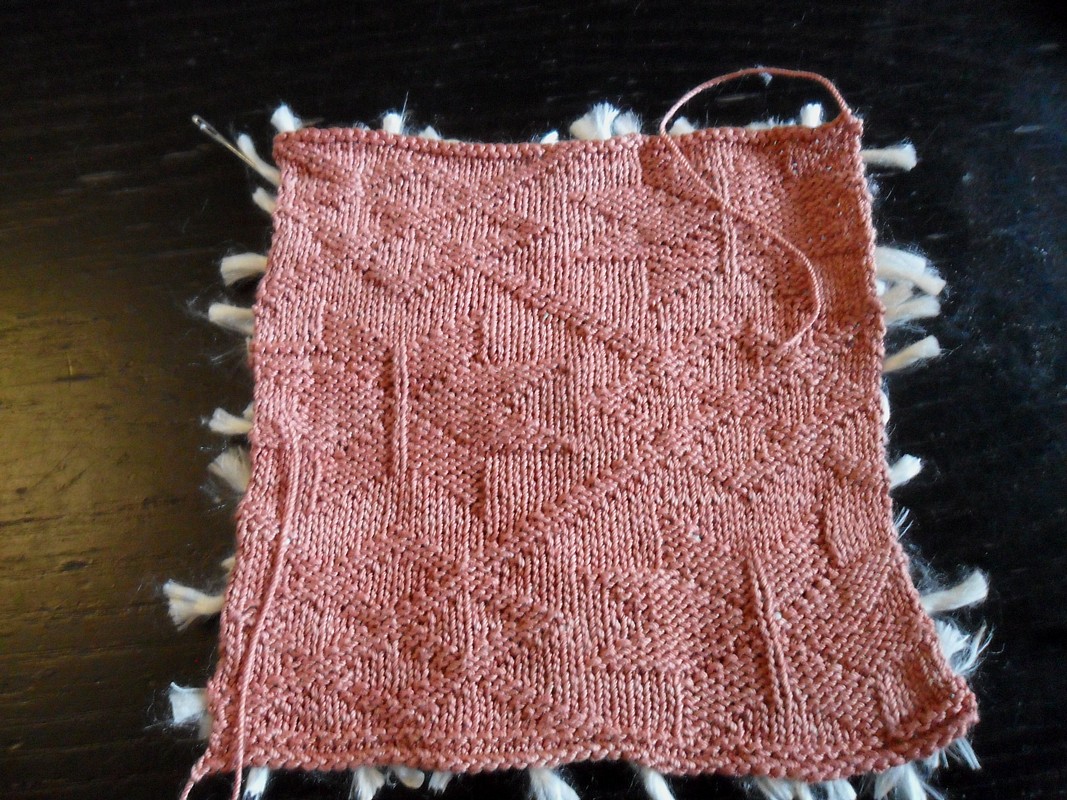
So, at Double Wars I am going to give a class on renaissance knitted garments:  waistcoats, sleeves, stockings, hats and mittens. I am of course going to bring my knit silk Eleonora di Toledo stockings, but I thought that it might be a good idea to bring some samples to let people see and feel how these garments may have looked and felt to wear.

My first sample is damask knitted silk with a knotted in silk pile. This technique was used in waistcoats and sleeves in the Nordic countries in the 17th century, which is too late for teh SCA of course. Knit wool sleeves and knit silk waistcoats are, however, known from many European countries from the 16th century. So, even if none of this particular type are preserved, I thought it worth trying the technique and showing the result. I was naturally especially tempted by the fact that we have one of the preserved 17th century ones a our local museum and I have had the joy of examining it closely.

Most preserved knit silk waistcoats are from the 17th century, there are a few that could be dated earlier - if you want a lot of links to extant ones, you should have a look at this blog post.

Anyway, the yarn here is a little thicker than silk buttonhole twist, it also has a tighter twist. The originals generally had a looser twist, but I was working with what I had at home, more samples will be made later.
   I am using 1mm/US #00000 needles. They're carbon fibre, from KnitPro. I wish I had longer, steel ones though.


The dots on my kitchen table cloth are 12,5 mm/ 1/2 inch wide, so you get some size comparison.


Maj Ringgard has made the most recent analysis of the 17th century damask knitted silk waistcoats in her article  “Silk Knitted Waistcoats - a 17th-century fashion item” in Mathiassen, Tove Engelhardt, Nosch, Marie-louise, Ringgaard, Maj, Toftegaard, Kirsten & Venborg Pedersen, Mikkel (ed.), Fashionable encounters: perspectives and trends in textile and dress in the early modern Nordic world, Oxbow Books, Oxford, 2014. She found that of the damask knitted waistcoats those who were knitted in the round, which were the majority, had the silk pile knotted in afterwards, while those knitted in the flat had the pile knitted in.
   This sample is obviously knitted in the flat, but I decided to knot the pile anyway, for this sample.


Unlike the originals I used a different coloured, much looser twisted silk yarn for the pile. This was due to the fact that the salmon coloured yarn is to tightly twisted to give the soft pile you see in the preserved ones. At the same time the while silk yarn is both way too thick and too loosely twisted for the knitting.
Having seen the knit waistcoat at Gothenburg City Museum up close I am not sure if it was the same yarn used for the knitting as for the pile, though it definitely was of the same colour. More testing will be done.

Anyway, this is how it looks when finished, from the inside and from the outside.


And it feels absolutely lovely on the skin. This was ptobably not an issue in period though, since you would have been wearing a shift or shirt under it.

It is unlikely that I will ever knit a whole waistcoat, it is boring and slow work to knit on so small needles, but I will look into the 16th century sleeves more and may make a pair from wool when I start makign 16th century clothes again - the coming years I will be concentrating on the 13th-early 14th century, as you might know.

måndag 4 april 2016

A new 13th century shift

Somehow all the shifts that I made ten years ago have been worn out. I have one new from 2014, but the other ones really need replacing.

So before I went to Crown I cut out a shift and then I sewed on the way there, at the event (a little, during the tournament) and the way home. And this afternoon I finished it.

I've had the linen for eight years or so. I like self patterned linen and I thought that the stripes gave it a 13th century Spanish feel. After all they had a lot of striped clothing, even if I haven't seen a striped shift yet.


Keeping with the Spanisk influences I used Dona Teresa Gil's shift as my pattern.

Photo from the history blog Nonnullus

I see that iI shoudl ahve made the slit at the neck much deeper, but I'm not sure if I'll change that. After all, I am not nursing anymore, and haven't done so for nine years, so I need it.