torsdag 5 april 2018

Making a 14th century night cap

In only a month the SCA camping season starts with the event Double Wars. And since we are having a very cold spring (due to the record high temperature at the North Pole pressing down cold air further south) I am more than a little worried about keeping warm in my pavillion before hubby joins me after four days.
Asking advice about heating the pavillion (I am leaning towards this) a guy in our local group mentioned that you (obviously) shouldn't keep it running when you are asleep, and that you heat up you pavillion, put on your cap and crawl into your sleeping bag.
Well, I do have a sleeping bag, and lots of modern caps (I'm an enthusiastic knitter), but I thought: wouldn't it be cool with a period night cap?

There are lots (well, relatively) of preserved ones from the late 16th - early 17th century, like this one, from the Cleveland Museum of Art:


But since I mostly make earlier periods I wasn't that interested in making one of those. I am also sure that it wouldn't be comfortable to sleep on the embroidery - they were after all probably mostly worn as undress rather than for sleeping.

But they did use night caps, for instance Les Quinze joies de mariage from the 14th century mentions the wife providing night caps for overnight guests. And there are images, though it took me a few hours of browsing through my vast collection of 14th century Italian images to find a few:

The women here appear to be sleeping in St.Birgitta caps. Which is only reasonable, they're extremely practical.


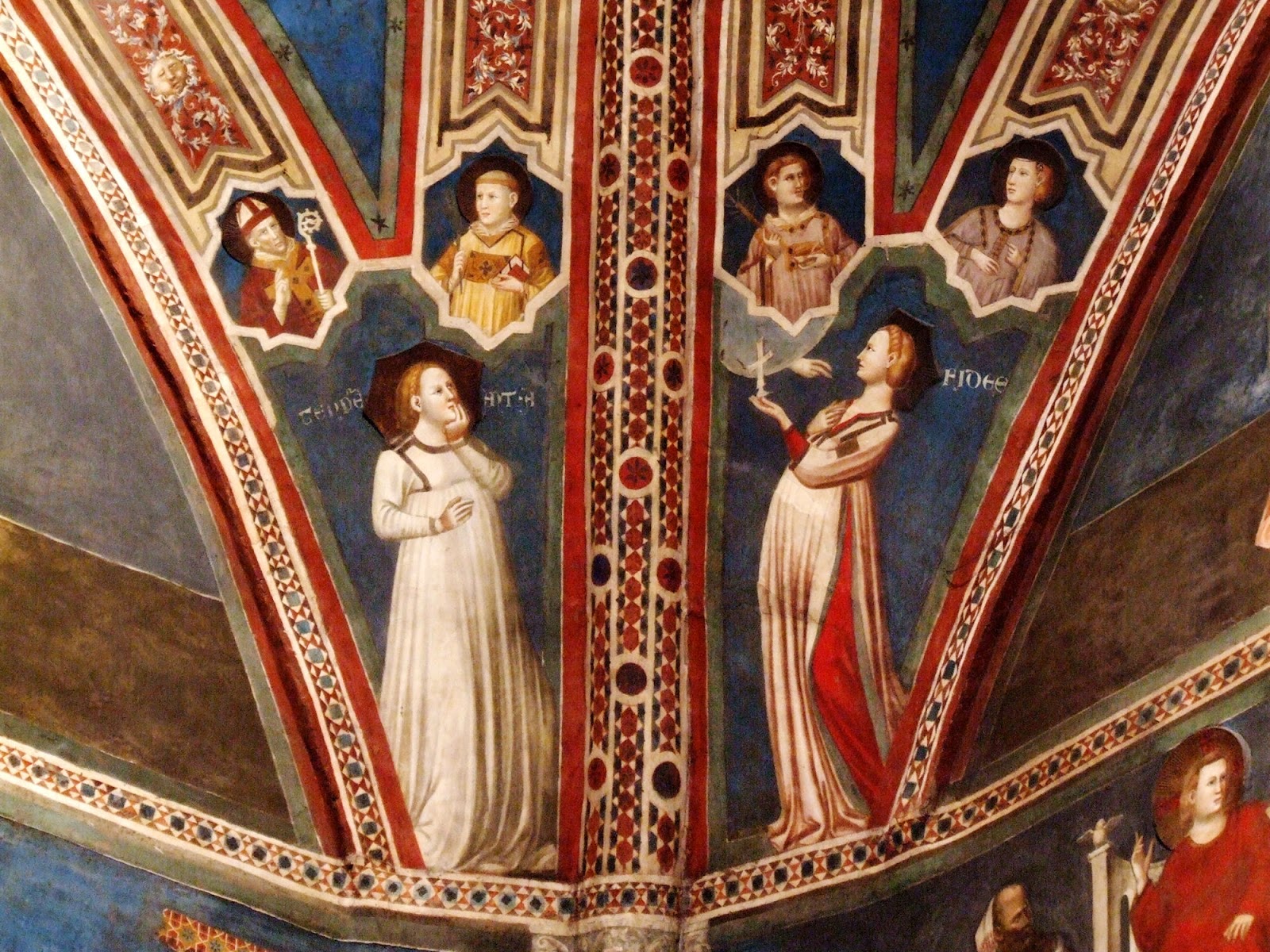
However, I wanted something warmer, made at least partly from wool, and found these Italian paintings:

Barnardo Daddi:


Memmo di Filippuccino:

The last one is from San Gimignano, and from 1306, which is one of the periods I mostly wear. I find it interesting that sh'es naked except for the cap :) And it shows that women also wore this kind of cap at night.

So I made a night cap from red wool, lined with white linen. The lining is slip stitched in place at the edge and easily removable for washing.


And finally: Some ordinary caps that I thought were intriguing and could be used for night caps too maybe:


onsdag 28 mars 2018

My next (?) project

This may not be my next project, since there's always the possibility that I'll make something quickly for Double Wars for instance. But it is the project that inspires me and fuels my clothing research right now.


This is a leaf from a treatise on vices, owned/comissioned by the Cocharelli family in Genoa c. 1330-1340. This particular leaf is at the Cleveland Museum of Art (link to the manuscript leaf and a high resolution view of the illustration above). A few other pages have been preserved and most of them are at the British Library (link).

The motif is queen Accidia, personifying Melancholy, who can't even be enthusiastic over board games :)
The text at the Cleveleand museum of Art stresses Islamic influences in the textiles, and in the jeweled headdresses of all women except Accidia. They do not mention the dress of the women as specifically ifluenced by Islamic culture, which is wise, since both the type of garments worn together and the way thatthey are decorated are found in many images from late 13th to mid- 14th century Italy.

I have already written about Italian gowns with high waists, belted and with seams (as well as making one of silk and one of cotton).
Blog post 1.
Blog post 2.
Silk gown
Cotton gown

So high waist seams are definitely something seen in Italy at this time.

The placement on the trim of the two non-striped highwaisted gowns is also rather common, here are just a few examples:

The Tolentino basilica


The white gown is also split down in front, as the gowns in the Cocharelli treatise.


While the woman to the right below has a gown that is split at the sides.


I have (of course) also written a blog post about split overgowns in the late 13th- early 14th century, it's here.

The fresco San Zeno in Verona which was the inspiration for my teal silk gown, also has decorations which are similar to the ones in the illustration at the top of this post. And, of course, the high waist seam.


Ambrogio Lorenzettis painting of the bad and good judgement shows a woman in a dress with the same trim placement as on the Cocharelli treatise, almost like a yoke.


St.Ursula, from Chiesa di St. Orsola in i Vigo de Cadore in the Veneto.


As for overgowns split both at the sides and in front (and possibly in the back), as the woman in the mi-parti outfit has, there are examples of this too, like this: Giovanni Baronzio 1325-1350, The Life of St. Columba


As for the headdresses being Islamic inspired I don't know enough about Islamic dress to say anything about it, but one can note that wearing your coronet/crown tilted back is not that uncommon in 14th century Italian art.The added jeweled band seems a little odd though.

This of course needs to be examined further.

But if anything it is queen Accidia that looks... - almost French, rather than Italian.

I haven't yet made up my mind which of the versions that I want to make. The mi-parti one is cool, the white unusual, but the striped ones are more insane, and I tend to go for that.

fredag 23 mars 2018

Close-up of closures in the 15th century

Last week I was in New York - a big adventure, though spent in a very familiar way: museums and a conference. I took no less than 1993 photos, though about half of them are of the signs telling what I actually had photographed.

Since so many art historians (and others) have used the collections of the Metropolitan museum of Art, that most of the paintings are well-known by anyone interested in historical costume. Still, it's nice to have your own photos, and when you're there you can take detail shots of things that interest you - like closures on clothing in the 15th century.

Workshop of Andrea del Verrocchio: Madonna and child, 1470s. Both nice ladder lacing on the bodice and a good view of the ties on the sleeves.


Raffaellino del Garbo 1490s-1500? Detail of sleeve closed with pairs of clasps? Or buttons?Note the stripes on the smock.


Domenico Ghirlandaio 1488, close up of boy's sleeve closures. Look at the fur lining showing and the lovely brocade too.


Davide Ghirlandaio: Selvaggia Sassetti 1487-88 - look at the beatiful little metal "eyes" for lacing.


This one's from the Pierpont Morgan Library and Museum. Nice view of the front opening.


Close-up - you can really see the pleating, the ties,  and the smock under the gown.


And then a Flemish Madonna from the Met, look at the buttons on her sleeve. Master of teh legend of St.Ursula, late 15th century.


More Flemish, Hans Memling: the Annunciation, 1465-75. Nice buttoned sleeve.


söndag 11 mars 2018

And the second painted chest is finished

And tonight, the night before I leave for New York and the Inside Out: Dress and Identity in the Middle Ages  conference at Fordham University, I finished my second clothes chest.

The first one had a variety of courtly couples on it (see it here) For this one I decide to keep to one medieval story, the story of Lancelot and Guinevere.


I want to move one of the hinges about one millimetre, but that will have to wait until I get back.


tisdag 6 mars 2018

Regency outing

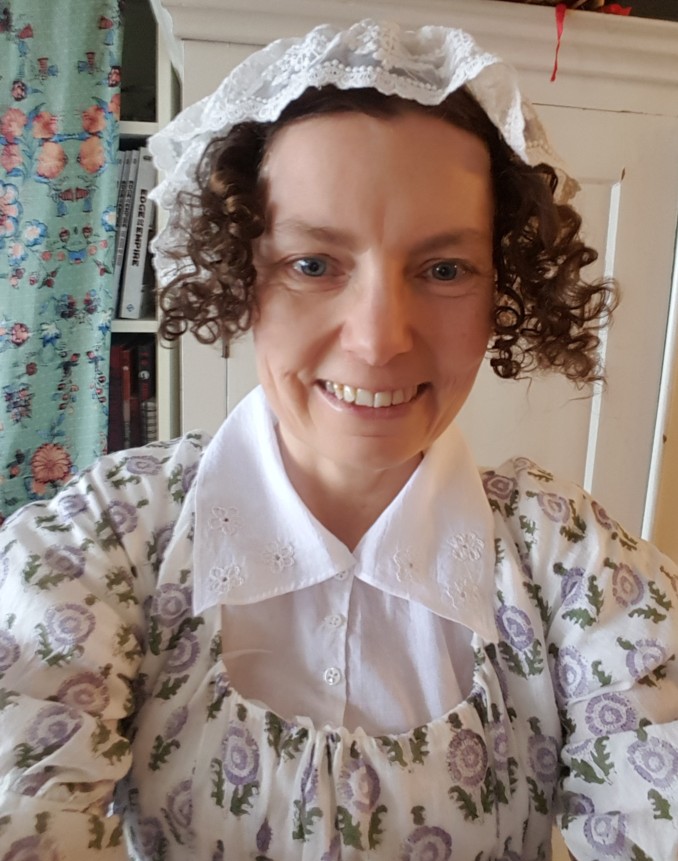
Today the various university departments here in Gothenburg had a chance to present themselves to high school students and I had been asked my my department, the Department of Historical Studies, to represent hisitory - and to dress up for it. Since the archaeologist showed a 12th century skull we decided that it was better with another time period than medieval. So I put on one of my regency outfits. It was a bit tricky, since hubby wasn't at home to help me with the ties in the back of the gown. I managed, but couldn't really hide the ties properly by myself. Luckily I ran into hubby downtown who not only took a photo of me, but also helped my with the ties.

On my way out, channeling my inner Mrs Bennet.


Outdoor selfie.


The photo Rickard took outside a part of the university library.


After the presentation I met up with my daughter Valeria and we went in to the libarary together, where some more photos were taken.


söndag 4 mars 2018

Nordmark Coronet Tourney

It was a lovely event, with wonderful people and lovely sunny weather with no wind.

I stayed in a cabin with hubby and two friends. Getting dressed after arriving:


Coronet Tournye took place on the tennis court outside the building where the event was held.


Lali, Gele, my Laurel, mistress Helwig, and Druda.


Rickard and I

Posing in winter clothes


I made a scroll, knitted some, hung out with friends, sold a gown that is way too big and drank too much alcohol :)

måndag 26 februari 2018

Painting more glasses

Since last weekend I am no more the baroness of Gotvik, and have passed on the glasses and cases that I made to the next baron and baroness. Of course I have replicas of historical glasses, but ever since I first saw them I have been fascinated by painted glasses from the Middle Ages and Renaissance. Especially the beaker shaped ones from the High Middle Ages, I wrote about them here, with a few pictures.

Unfortunately I haven't found anyone who makes plain beaker shaped historical glasses, they always have some kind of decoration. I am not sure if I would have dared to harden the paint in the oven with a historical replica either, but probably.

Since I can't have historcial replicas to paint on I have had to make do with a substitute with reasonably the right shape: beer glasses.
The upside to this is that they are very hard to break. And you can get them cheaply from 2nd hand shops.


The motif is my badge, surrounded by flowers, which were taken from the Aldrevandini Beaker in British museum, made in Venice in the 1330s.


The arms of the Aldrevandini family also has antlers, which provided the basic shape for the ones on my glasses, which are my personal badge in the SCA.

In the SCA you can register both your heraldic device/arms and one or more badges. This is based on a period practice: Since arms were hereditary it was  common among the nobility at least in the Later Middle Ages to also have some kind of badge which signified yourself, rather than your family In the SCA arms are personal so the distinction between the two is roughly that my arms say "here's Aleydis" and my badge say "I belong to Aleydis". Badges can be jointly owned too, so that they signify for instance a household, and while my badge technically is registered to me only it can be used by any member of my family/household.

My badge is a deer's antler with a white cinquefoil, that is a flower with five petals, om each tine. The flowers reflect my device, and I got inspired to put them on the tines of the antlers from this Codex Manesse image.


Next step is to make  box for all six glasses that will make it easy to bring them to events.