onsdag 17 juli 2019

The tale of the mantle

In the beginning of this month I went to the International Medieval Congress in Leeds. Together with two friends I had session about materiality in Arthurian literature. My presentation was about clothing and textiles in six romances translated to Norwegian and Swedish in the early to mid-13th and early 14th century respectively. One of these, the so-called Möttuls saga was probably based on the Old French Le Cort Mantel, and was adapted into Old Norse  by a  cleric known as Brother Robert, probably of Anglo-Norman origin, for King Haakon IV of Norway (1217–1263). 
The Norse text can be found in its entirety here.

The tale is about a wondrous cloak which tests the fidelity and virtue of the woman who wears it, and the story in the Norse version is rather comic and somewhat bawdy. The cloak is very beautiful; made from red silk and is gold embroidered all over with leaves. it is held together with cloak ties and if the woman wearing it is virtuous, it should reach all the way to the floor. A man brings the cloak to the court of King Arthur and demands that all women at court should try it on.

Unsurprisingly all but one of the women at King Arthur's court fall short in this test; the cloak is eithr too short or too long, and often both at the same time, indicating, according to the tale, in which position the woman had been unfaithful.

So much about the story, but when I worked with this material I felt a very strong urge to have such a cloak, though without the magic. Silk cloaks are not unheard of in medieval Scandinavia, I found three in Norwegian documents when I did my PhD dissertation:

* One, is in a woman's will from 1349, and it is made from blue silk and has skillmala, an unidentified type of ornament. Link to the document.

* One, from 1353, has no mention of colour, but was lined with ermine and edged with sable and also had lade, a word that means woven or embroidered trim. This is a man's will, but it also contains items of women's clothign, so the cloak may also be a woman's cloak. Link to the document.

* The latest one, is in a document dividing posessions between a brother and a sister on the occasion of her wedding in  1366. This cloak was given to the woman, was green, lined and edged with ermine and had gold ornaments made in Norway (norröna). These were probably cloak clasps, since bezants, the metal ornaments so common in medieval fashion were usually silver or gilt silver. Link to the document.

So, I decided that I really need a floor length silk cloak.

Cloaks from this period were semi-circular - one such cloak was found during excavations in the church of Leksand in Sweden. The cloak, which is dated to the 12th or 13th century, was made from a diamond twill wool and had a border of woven trim along the straight edge of the semi-circle. This cloak was probably long enough to reach to the wearer’s feet in the back. Marc Carlson has a page about it, which shows an estimation of the cut, and more information can be found in Margareta Nockert's article ’Textilfynden’,  in Tusen år på Kyrkudden, red. Birgitta Dandanell, Falun 1982.

I looked around for reasonably priced silk when I was in London on my way home from Leeds, but I didn't find any in a colour I liked. However, this week I passed the town of Borås, known for its textile trade, on my way to a friend's 50th birthday celebration, and there, at a shop called Furulunds, I found a gorgeous raspberry red silk. The photos do NOT make it justice.


Now I "just" have to make the embroidery. And decide HOW to make it, which means more research. I will keep you posted.
It will be lined, probably in another silk, but given the time the embroidery will take to make I don't have to look for lining fabric this year.

The Korean project is moving along

We decided that Maja and Valeria could use the same fabric for their chima, and the same cotton for their jeoksam, the blouse worn under the jeogori jacket in the medieval period. Valeria will have a light blue linen jeogori and Maja will have a light green cotton jeogori, but I haven't started on those yet. After all they're not going to wear them until November, and I have other interesting projects.

Valeria in jeoksam and chima.


fredag 21 juni 2019

Medieval and 16th century Korean dress: A chima

So, it appears that a new(ish) interest is Korean dress from the period that the SCA covers. Mainly because all my daughters are huge K-pop fans, and thus became interested in everything Korean.  The fact that my 1330s Genoese outfit reminds everyone of a woman's hanbok because of the high "waistline"also helped.

So, the plan is to make 14th-16th century style hanboks for both Valeria and Maja. I started yesterday, at Gotvik's sewing meeting, by making a chima (wrap skirt) for Maja from a linen/cotton blend. Ideally it should be hemp or cotton for lower class garb, and ramie or silk for higher class, but this is such a lovely fabric. And it has stripes, which was popular for unmarried girls and women.


The chima was pretty easy to research, there are several preserved ones from this period, such as these:

A chima made for Jung, On (1481~1538), a 5th class officer in the reign of King Joongjong. It is made of fine tabby silk and has various Buddhist scriptures around the knee portion. This suggests that this Chima was specially made for a placement in coffin as an element of the burial, and also as an offering for the late husband’s soul to rest in peac


This unlined ceremonial Chima was worn by Lady Han of Cheongju (region), a great-grand child of King Joongjong. It is made of satin damask with a lotus and seven treasures pattern and is decorated with two lines of satin tapes made with supplementary golden wefts to create a lotus and child pattern.

But I need more info for the rest of the outfit. I have ordered Traditional Korean Costume on ILL, and I have found two blogs with historical info, as well as a wonderful artist on DeviantArt who draws historical Korean outfits.

A hanbok fit for a 16th century Gisaeng.

So steady as she sews

Glimja at DeviantArt

And I am ever so grateful for the Metropolitan Museum of Art for making so many of their publications free to download. Like this: Art of the Korean Renaissance.

My Pinterest page on Korean dress, which includes later periods


måndag 17 juni 2019

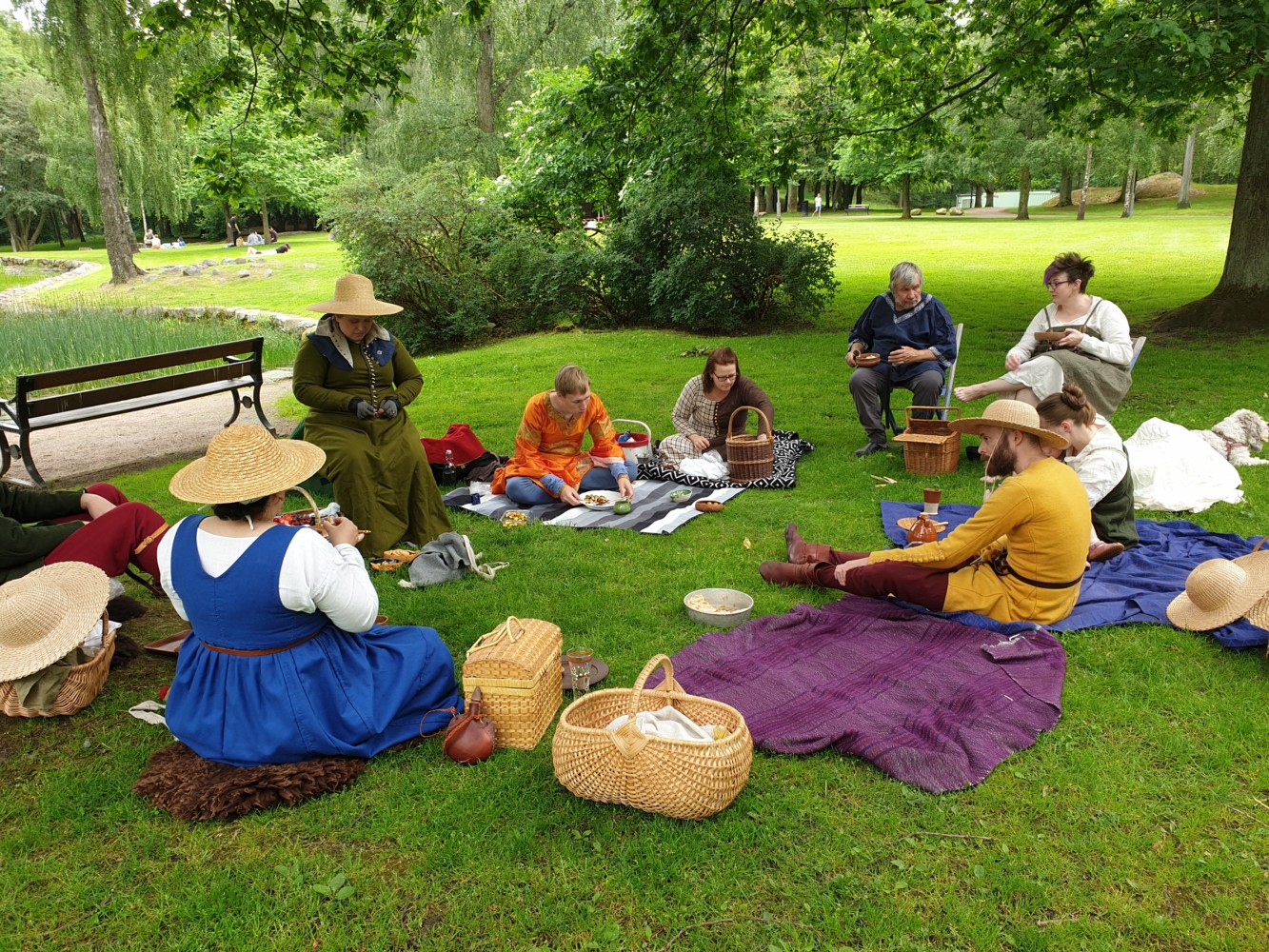
Gotvik's summer picnic

Every year in June Gotvik holds a summer picnic in Keiller's park, and this year it was last Saturday.

It was a really pleasant afternoon, which included socializing wtih really nice people, yummy food, harp musc, a toddler, dogs, and a stranger asking about us and ending up being at least close to recruited ;)


I wore my remade gothic fitted dressed, originally made in 1998.


And the (for me) obligatory selfie when historical clothing on public transport ;)


torsdag 13 juni 2019

A new 16th century knitting project

As you might have seen I have made several flat caps from the Gagiana pattern that Marion McNealy constructed  based on a preserved flat cap from the 1583 Italian shipwreck of the same name.

Two of them


I also used the same pattern as starting point for one of those 17th century knitted tall hats that they have found in Denmark.


Photo by me, from the National museum in Copenhagen

That one wasn't a perfect success, so if I make another one I will make some adaptations to the pattern.

But, happy as I am with the Gagiana pattern - it is easy to follow and makes excellent flat caps - I have now had the opportunity to have closer looks at preserved flat caps at the Germanisches Nationalmuseum, plus photos from other museum collections and I have come to the conclusion that at least most of them are made from thinner yarn than worsted. I also want to make a split overlapping brim. I know that there are patterns for that which you can buy, but I'm cheap too ;)  So I may have to make my own pattern (how hard can it be? Famous last words). I am making it for Sir Måns, because my husband doesn't wear 16th century.

I was thinking about using fingering weight, but then I fell in love with this sport weight yarn.  It is from a local spinning mill, and really nice to work with. 

I started with knitting a swatch, which will later be hand (or foot) fulled). it is 35 stitches and 25 rows on (from bottom) 3 mm, 2,5 and 2 mm needles. I'm sort of hoping that the 2,5 mm will be fine enough.


Now I will measure the swatch before felting. "Now" as in when I have worked some more on an article for The Journal of Dress history.

torsdag 6 juni 2019

Maintenance Monday...and week

Someone in Drachenwald started the idea of "Maintenace Mondays", when you take care of you historical clothing and other stuff needed for our hobby. I don't keep with it regularly, because generally I am so good at fixing stuff that I don't have anything to do in that field most Mondays.
   But after a big event such as Double Wars there is of course a lot of things to do: like cleaning the bottom of your wool gowns (which are white wool or lined with white wool), with a sturdy brush and soap. And washing all your linens.

But I also re-made this bed spread, made from wool and fake fur:

Before:


I made it 13 years ago or so, when I was a member of another medieval group, and it has the devices that my husband and I had registered within that society. When we (re-)joined the SCA we couldn't register exactly the same devices, but of course I could still use my bed spread.

It was, however, made when Rickard and I, and little Maja, still slept on two 90 centimetres wide foam matresses and thus way too big for our new 120 centimetre bed (which Maja doesn't slep in ;) ) Still, I made it work reasonably well. Until this Monday when I decided to remove the fake fur and cut it down to make a smaller bedspread (from 210 to 170 cm). And when the fur was removed I could just as well re-make the devices.

It's a bit wrinkly in the photo, partly because of the lumpy bed under it, partly because it had been packed in a very full plastic tub while slightly damp. It will get better.


But now it will fit our bed better, and have the correct devices.

tisdag 4 juni 2019

Some more Double Wars photos

Me and Julia Margaretesdotter getting awards for service to our barony,

Photo by Agnes Edgren/Countess Agnes Odygd

Fru Elisabeth Thorbyornsdotter getting both St.Egon's bolts, and her Award of Arms


 Fru Elisabeth and Fru Julia in our camp


 Hubby in the woods