torsdag 16 mars 2023

Folk dress of the late 18th century

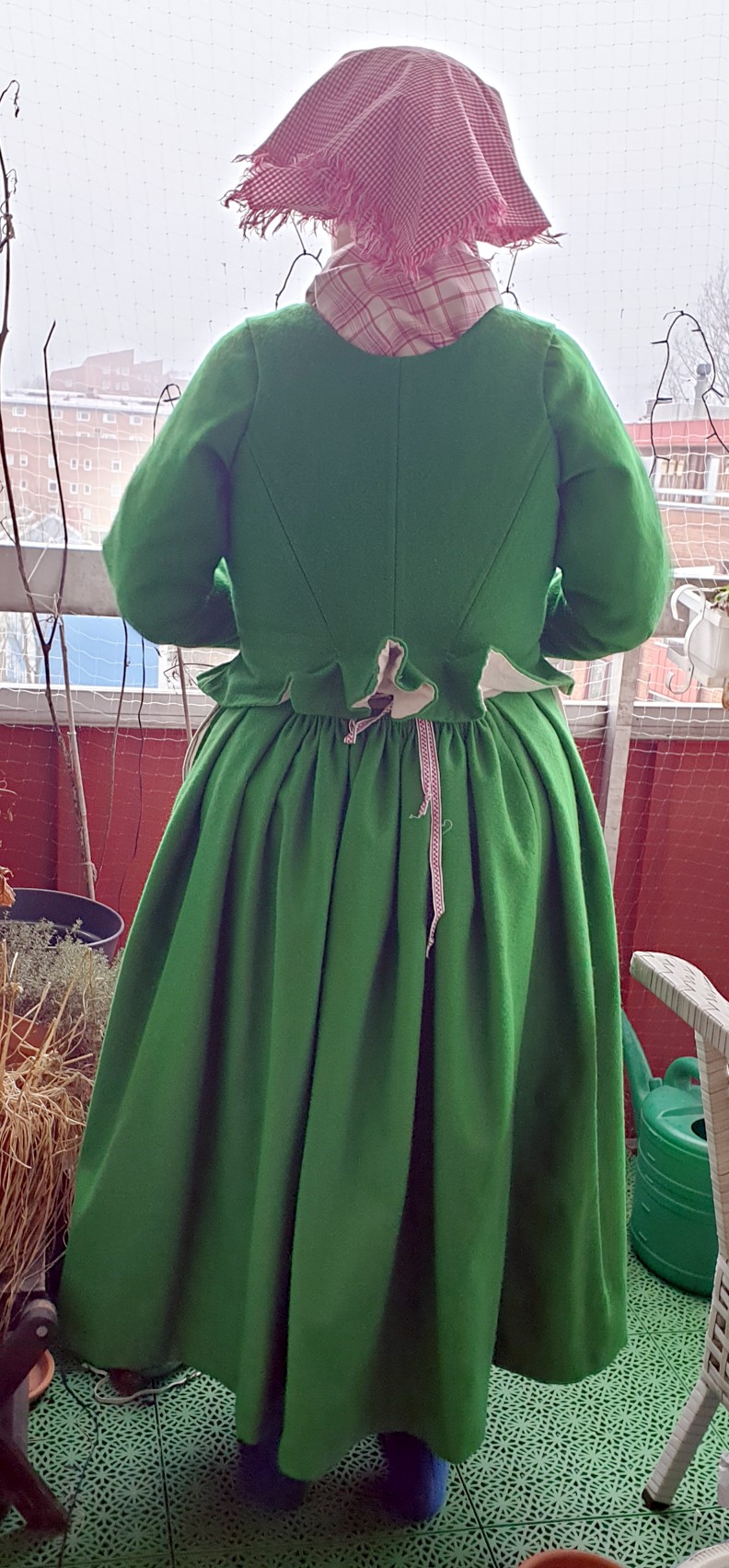
 While working on a lecture about my folk costume and the studies I have done of rural manners of dress in that area i realized that I never posted photos of my green frieze (vadmal) skirt and jacket that I made about a year ago. The fabric is from Korps. Jackets and skirts made from green frieze is very common in the probate inventories from the time and period that I have been studying. It is a very strong green, but it is close to preserved frieze skirts from another part of Västergötland, and it was as close as I could get.

I made the pattern based on several preserved alte 18th century folk jackets, and the skirt is made the same way as my red folk costume skirt. All hand sewn of course. 

The jacket is closed with lacing in the lining, and then pinned shut.

The jacket is worn instead of the sleeveless bodice in colder weather. The apron is striped cotton, a thrifted curtain, the head scarf is also thrifted, but the neckerchief is bought from Folkdansringen Göteborg.

måndag 27 februari 2023

A short visit to the 1830s

 My sister Lena (her blog, which is mainly about food) has decided that her husband's 45th birthday party should be a 19th century dinner party. Only people insane enough to want to make outfits were invited. And of course I was one of them.

We could go for any part of the 19th century, so I could have worn my 1810s ball gown, which I haven't worn to any event yet. But making something new is more fun, so I ended up making an 1830s evening gown.


The fabric is cotton, and a gift from my friend Amanda, who was clearing out her grandmother's stash. It is trimmed with new velvet ribbon, new satin ribbon, and vintage cream lace that I have bought at charity shops. 

In addition to the dress I made a new pair of 1830s stays, a new corded petticoat, a petticoat with a ruffle at the botoom, and some padding to wear over my hips and bum.

You can see some of them here: the petticoat, the pads and the stays, and me making a toile for the bodice.


The two big cheats in this project are that I used the sewing machine for all the construction of the dress, stays and and pads, with hand hemming, lacing holes, trimming  etc. and that instead of making arm crienolines to keep the puff sleeves out I went for the theatrical solution of stiff tulle inside.

The corded petticoat is, on the other hand, entirely hand sewn.

For the hair I also used modern methods: I put more hair gel in my hair than I have since the 1980s. The decoration is made from scraps from the dress and artificial flowers intended to put around a candle, also thrifted. I was shoprt on time with both the hair and getting dressed, because I accidentally played computer games too long, and had to really rush it to catch the tram. In all I had 40 minutes to do my hair an dget dressed and I think it turned out rather well. 

And that gel was firm .- this photo is taken on the way home, after a dinner party and some rather brisk walking outdoors for 1,5 kilometres to get to the tram home. 

Actually, all the photos are from after the party, this one is the only one I managed to take before running to the tram.


The petticoat is too long, I have already removed the waistband to make it shorter. It is made from a decorative bottom sheet with a valance that I got at a charity shiop, like so many of my things.

torsdag 12 januari 2023

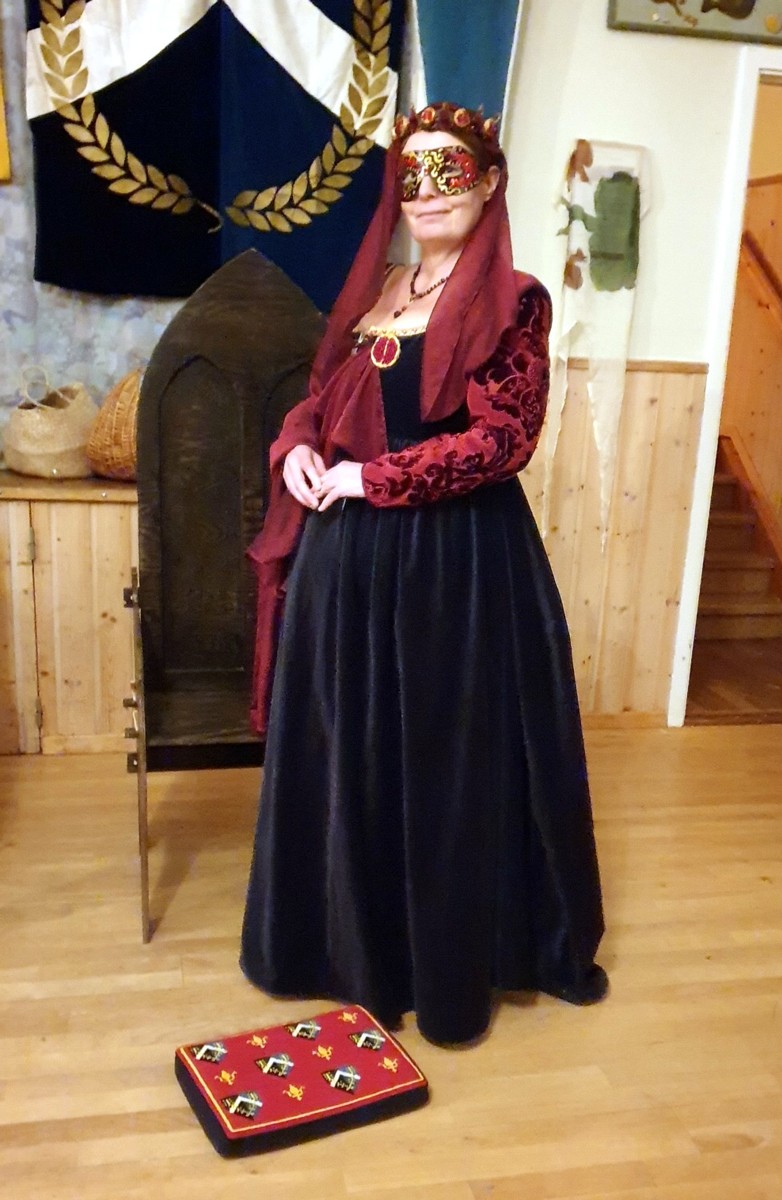
A 15th century Propserpine


So, Gotvik had decided that our annual autumn event: Festivalo de Caderas, should include a masked ball. 

I had planned to do research on masked balls in the medieval period, but I didn't have the energy this autumn. However, what little I had read about it suggested that they were more common in the renaissance. It also appeared that Allegorical figures and Roman deities were common in masked balls and in masked parades. 

So, since the ball  was close to All Hallows/Samhain I decided to go for something related to the Underworld: Proserpine/Persephone, queen of Hades.

Read all about the gown, the sources, the making, and the accessories here.

lördag 31 december 2022

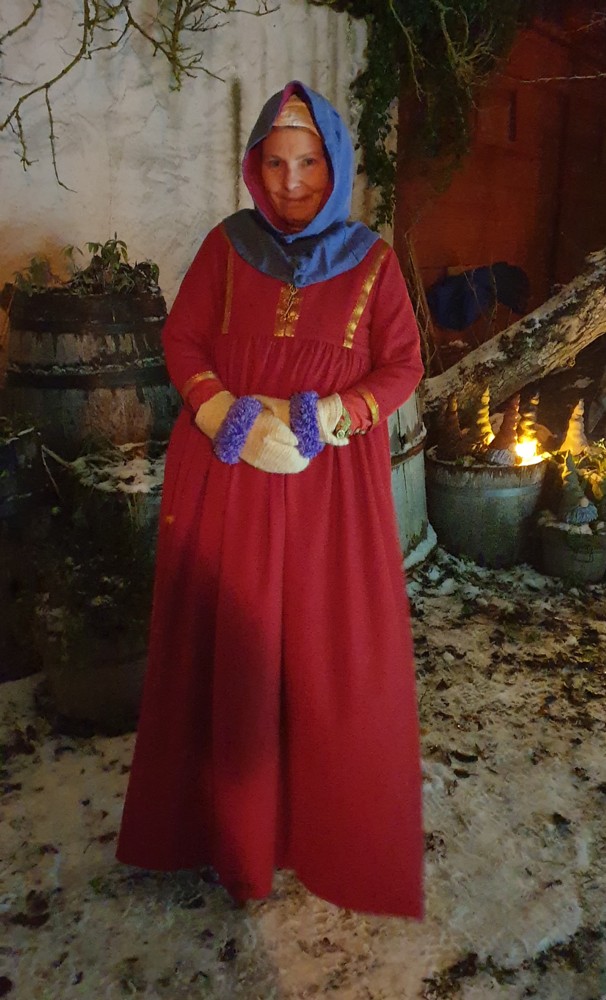
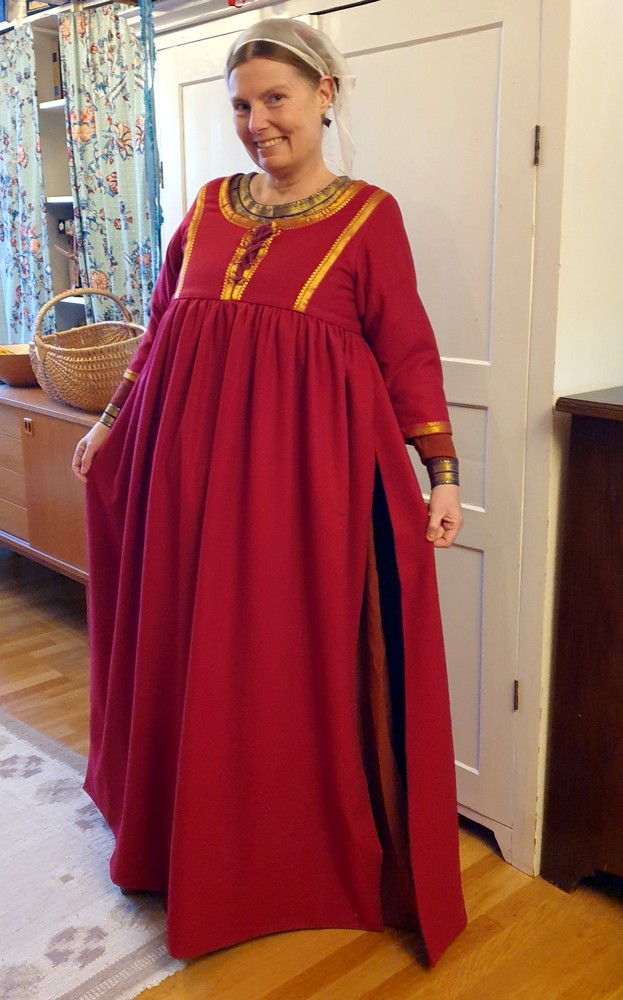
A red early 14th century italian wool gown

I don't blog much these days. I tend to make things, rather than write about them. And often I am too tired to do much more than post photos on Instagram. After all, I did start my webpage in 2000, so there have been many years of writing about my historical costumes. Aside from my professional writing on clothing in history.

But maybe this is the re-start of blogging, who knows?

Anyway, my newest medieval project was a red wool gown that I wore to Medieval Christmas, and Styringheim's Lucia Feast in Visby in the beginning of December.


To keep warm I wore  thick sewn wool cloth stockings, a linen shift, my quilted sleeveless shift  a thin wool kirtle, and the red wool gown, naalebound mittens (not made by me) sometimes a wool cloak and a wool hood lined in silk, or a two layer silk veil. And very modern boots with wool pile lining. I wasn't cold at all.

For my sources, inspiration and further information on construction etc, see its page.

måndag 21 november 2022

Too many things made - and too much work to document them

 I HAVE been sewing the last motnhs, but I have been too busy with my paid work - mainly recording lectures on fashion history for a course at Gothenburg University, where I work. 

I have also planned and cooked a medieval feast for 40 people, which took a large toll on my strength. My arthritis is really bad at the moment.

So, blogging has been very low on my priority list. I show my projects on Instagram, and that's about it. However, I will make proper posts about my three latest projects - later

Now you have to be satisfied just with some photos.


* A 15th century Italian masquerade outfit for the masked ball att Festivalo de Caderas, Gotvik's autumn SCA event


* A working class wool Regency wool spencer.


* An early 14th century Italian wool dress, of the by me beloved type with a seam over the bust. (I've written about this style here and here, and a little bit of everywhere, I really do love it)


måndag 19 september 2022

Gotvik's autumn picnic

 My SCA barony Gotvik, and I, arranged a picnic for newcomers and old hands, and everybody else, last Saturday. You can never be sure about the weather in Gothenburg, but this day it was fantastic. Sunny and warm (for mid-September) and we had a lovely day, with severeal new people joining in.


I had chosen the place, Näckrosdammen Park, becvaus it is central, and close to the Faculty of Humanities, so it would be easy to find for students, who might be new in town. It is also easy to reach by public transport, and accessible with wheelchair.

What I didn't know  was that this year they had placed two picnic tables at the spot I had chosen - which made it even better.

We started out with one of the tables, but soon we needed the other one too.
 As you can see I brought one of my new bench cushions. I have made two now, but since I carried everything that I needed to teh picnic I couldn't bring both.


I did bring table cloths, and some of my pottery and bentwood boxes though. Lady Alfhild and I had both made cookies to share, otherwise we usually bring our own food. I hade made meat mince pies, which you can see on my lovely, thrifted, replica of a 17th century pottery plate from Karlstad in Sweden.


I brougth extra pottery plates for serving too, because I really need to use some of my enormous amount of feast gear.


And what did I wear? Well, early 14th century of course, one of my trusted Codex Manesse outfits.
This photo is from when we were packing up at 5 pm, when our site was in shadows, hence the cool colours.


torsdag 23 juni 2022

A cushion for one of my benches

Camping events always makes you inspired to make more stuff for your medieval camp. And I have now made a bench cushion.

 In 2001, when I made my large tent my stepfather also helped us made a large table and benches, which has been used by both Nylöse and Gotvik, the two medieval groups that I have been member of for many years. They're very sturdy, and easy to take a part.

But it IS nicer if you have a cushion to sit on too. So when I found this embroiderd piece of fabric in a charity shop in the beginning of June I started thinking about making it into a cushion. 


The box, and the towel which you can see a little of was also from this charity shop, Erikshjälpen.

But, for something to sit on you want a sturdier stuffing than for a normal pillow, and I was thinking about what to use. Traditionally wool, cotton batting or feathers would have been a solution.

But then, while at another charity shop last week I saw all the cushions intended for outside furniture, and realized that the easiest way was to take one of those, cut it down, and use it.

And luckily, this Wednesday at Mölndal's second hand I found one that already was the right size.


Since ti would be stupid to have the emboridered fabric all around the cushion - after all the underside gets worn, I used another charity shop find: handwoven flax tow yarn twill, from Lindra Wieselgren.


And here is the finished project, on top of a chest, because the benches are down in the storage, and taken apart, and that would be just too much work just to take a photo,