torsdag 25 januari 2024

Listening to me giving an overview of medieval fashion

 If you want to hear and see me give a class on the general deveopment of medieval dress, now is your chance!

This weekend the Kingdom of Drachenwald's Online University takes place. it is totally free, but you need to register - it is easy and done here: Registration link

There are lots of other very interesting talks too - check the schedule , but mine is on Sunday the 28th at 13.30 CET (Stockholm/Paris).

Basically it is the same class that I teach at my fashion history courses at Gothenburg University, but in English. It will give an overview and is excellent if you are somewhat new to making medieval clothing and don't know what you want to make, or if you've only done one period and want to try something new.


lördag 14 oktober 2023

The tale of the mantle - four years later


 In July 2019 I started on an embroidered silk cloak, inspired by a cloak described the 13th century  Möttuls saga. Möttuls saga is an Old Norse text which was probably based on the Old French Le Cort Mantel, and was adapted into Old Norse  by a  cleric known as Brother Robert, probably of Anglo-Norman origin, for King Haakon IV of Norway (1217–1263). I had made a presentation about clothing in a collection of Norwegian translations of courtly romances for Leeds medieval congress in 2019.

You can read more about the inspiration, the sources, etc in a blog post that I made then. 

Well, in November 2019 I hit total burnout, in fact I am still not well enough to work more than 25%, and while I have made lots of clothing since 2021, when I finally was able to sew again, the cloak was lying there, packed away in a fabric bag.

My friend Anna kept reminding me of it, whenever I complained that I didn't have any hand sewing for when we hung out watching historical costume movies/series together. But it was The Lazy Reenactor Girl's  30 days of A&S (Arts&Sciences) challenge in September this year that actually made me pick it up again.

I hade made around 90 centimeres on the front border when I put it away, and now I have embroidered another 240 cm. And some flowers. 


Since the cloaks is described as being embroidered all over with flowers and leaves, I have quite a lot of embroidery left to do. I'm startinf with the flowers spaced evenly over the whole cloak, and then I will have to figure out the foliage.I am using "gold" thread, with a strip of metal wound around a yellow thread, which I am couching down with yellow silk, green silk embroidery floss, and white sewing silk.


måndag 14 augusti 2023

Visiting a mid-18th century ship in mid-18thcentury clothing

Last week hubby and I visited Götheborg of Sweden, the world's only replica of an 18th century Ostindia ship. It was built 20 years ago, as a copy of a ship that sank outside Gothenburg in 1745. 

I had for some reason never been to see the ship, and I thought that it would be nice to dress up for it. So I hand sewed a mid-18th century working class outfit. You can read all about it, and get patterns for the cap, on its page.

Here are some photos.


måndag 8 maj 2023

50 years ago is history - right?

One can argue about fifty years ago being historical, but it really is - trust me! I'm a historian. No matter how much I would prefer not to think of my childhood and youth as "long ago" and "history" it is.

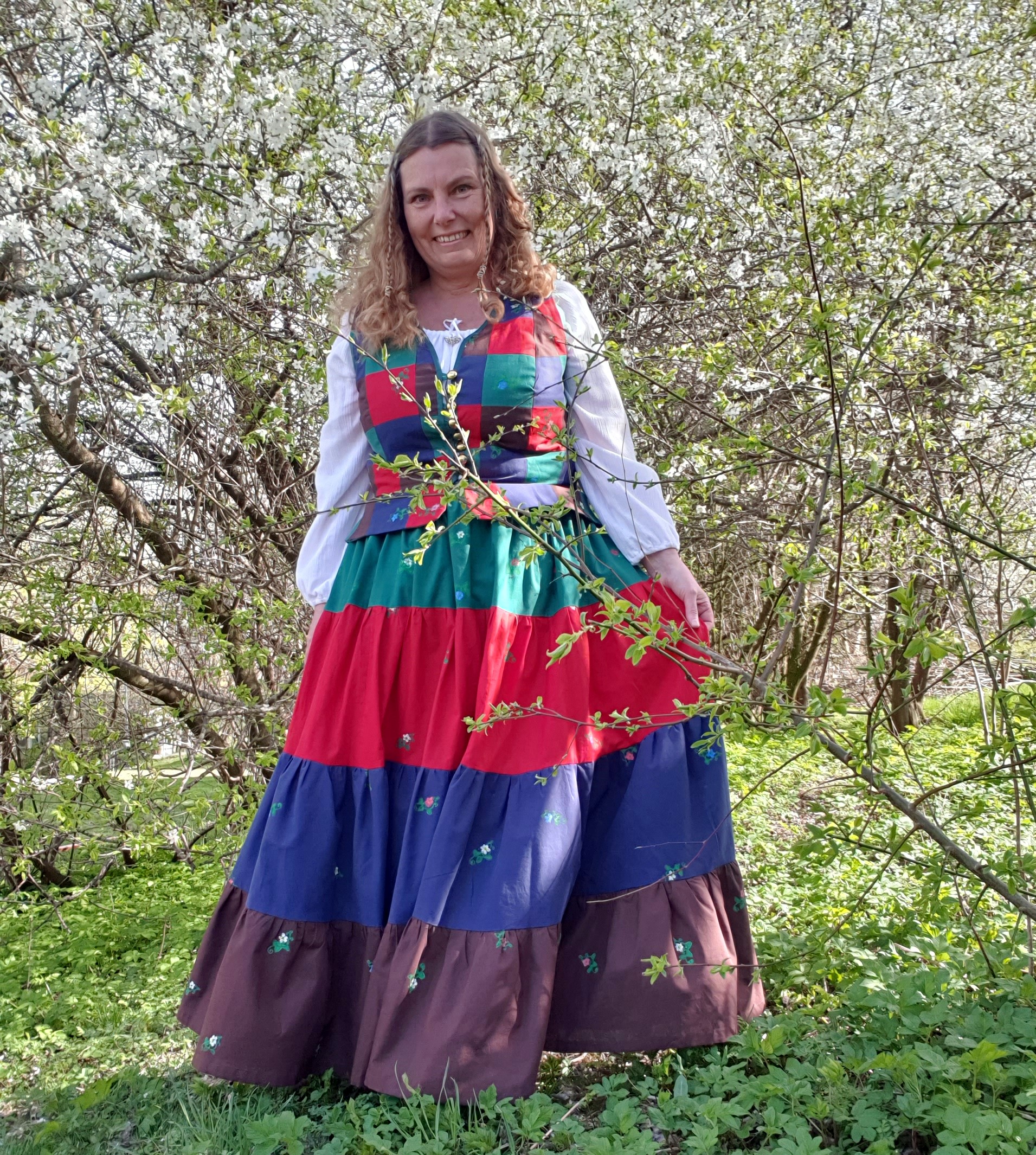
While that may make me feel a bit uneasy, it is at least a justification for adding my latest project to thei blog. Because it is a costume from a movei that was made in 1973: The cult horror/musical classic "The Wicker Man"

I love the film, but that's not the main rason for making the costume: ever since the late 1980s I have been very fond of hippie clothing, and the last 15 years I have even developed a strong liking for more mainstream 1970s fashion; I guess teaching fashion history makes you appreciate most periods, for their own sake.

So this outfit worn by Britt Ekland as the character Willow, ticked all the boxes for me: hippie-ish, but most of all an example of the folkloristic traits in 1970s fashion, which came as a result of the hippie counterculture.


She is wearing a peasant blouse, a tired skirt made from green, red, blut, and a brownish purple fabric in the same flower print.

Details, showing more of the waistcoat.


When I first stated thikning about making this outfit fie-six years ago I thought that it would be easy to find quilting cotton with the same print in different colourways. It wasn't.

In the end, this spring, I decided to do something about it myself. So I ordered a stamp from the seller Catfluff on Etsy


First I printed the fabric with green textile paint, and then I painted flowers in white, pink and light blue with a paint brush.


This was done on quite a lot of fabric, since the lowest flounce on the skirt is 8 metres X 27 centimetres, and the waistcoat also took some fabric.

The green, red and blue fabric are all thrifted bed sheets, btu for the brown I had to order new cotton broadcloth. And I had to make do with brown, because the original dark, brownish purple was nowehere to be found.

Anyway, I am very happy with how it turned out. These photos are taken (by me) two hours before our annual viewing party of "The Wicker Man".


fredag 14 april 2023

My husband's silk tunicella

 Well, it only took 17 years, but now it is finished for real. I had such great plans, then I made do with something less, and then in  autumn 2019 I decided to cheat and use machine embroidery instead of hand embroidery and cast bronze plaques. Then of course the pandemic happened, and I couldn't go to Alfhild and watch her embroider on my fabric.


The machine embroidery pattern is digitized by ArtEmbroidery on Etsy, of course based on the tunicella of the coronation clothes of the Holy Roman Empire, which you can see if you follow the link below. There are more info about the construction, previous iterations of decoration, and my husband actually in it: here is its page.

I have sewn freshwater pearls for more money than I'd like to think about along both edges of the embroidery on hem and sleeves.

I will update it when I have a photo of him in it.

måndag 10 april 2023

Another Italian late 13th-early 14th century gown

I found this blue wool at a charity shop this winter. It hibernated a while in my wool cupboard, before I could make up my mind about what to make from it. 

But in the end: who doesn't need another (very) high waisted Italian gown from c. 1300? (Read more about them here)

This is a very simple one, with no decorations. It is all hand sewn, and due to fabric limitations it also has some interesting pieceing in the bodice and one sleeve. Haven't worn it for an event yet, but maybe this wekeend, for St. Egon's Feast.


torsdag 16 mars 2023

Folk dress of the late 18th century

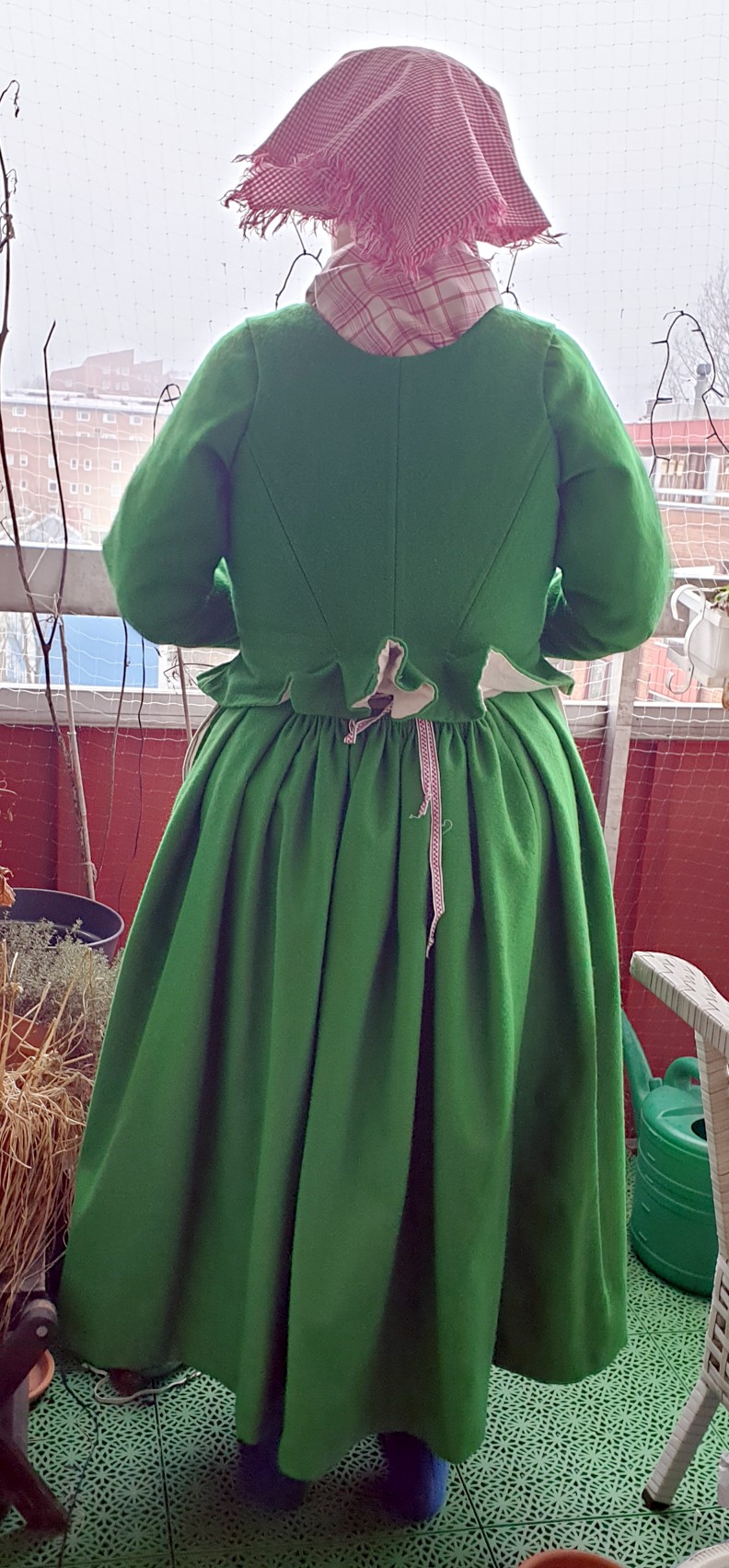
 While working on a lecture about my folk costume and the studies I have done of rural manners of dress in that area i realized that I never posted photos of my green frieze (vadmal) skirt and jacket that I made about a year ago. The fabric is from Korps. Jackets and skirts made from green frieze is very common in the probate inventories from the time and period that I have been studying. It is a very strong green, but it is close to preserved frieze skirts from another part of Västergötland, and it was as close as I could get.

I made the pattern based on several preserved alte 18th century folk jackets, and the skirt is made the same way as my red folk costume skirt. All hand sewn of course. 

The jacket is closed with lacing in the lining, and then pinned shut.

The jacket is worn instead of the sleeveless bodice in colder weather. The apron is striped cotton, a thrifted curtain, the head scarf is also thrifted, but the neckerchief is bought from Folkdansringen Göteborg.