måndag 18 januari 2016

Par vestimentorum – a set of clothes

When working on my dissertation, where I examined clothing in Norwegian and Swedish wills and other documents from the Middle Ages, I found several examples of sets of clothes of matching materials and colours, intended to be worn together. Two of the terms that were used were par vestimentorum/par vestium and robam integram.

The most common of these is par vestimentorum or par vestium. Exactly which garments these contained is seldom mentioned. It is only one will where it is explicitly stated which garments made up the set: Ragnild Hinzadotter's will from 1350 (it can be read here). In this par vestimentorum a lined cloak, a cotte (tunica) and a colobium with arm clasps. A colobium is an over garment, but apart from that we do not know much about it (there is also an early medieval liturgical garment with this name, but it is unlikely that this garment would be that, since it's as late as 1350 and owned by a woman). Since this one had clasps to close the sleeves it at least appears to have had sleeves that were tight at the wrists.

Robam, or robam integram are less common terms in the Scandinavian material, but appear to have similar meaning. Roba could of course refer to a singular garment, the long garment worn by men in religious orders and by academics from the 13th century onwards. In a Norwegian will from 1381 the roba, is however described as consisting of a brown cotehardie lined with buckram, a cloak with blue lining and a hood (the will can be read here). The term robam integram of course shows that there were more than one garment involved – for example the blue robam integram lined with vair which the canon Germund willed to his servant Haquin, together with a cloak and hood in the same colour. Form the way it is written we understand that the cloak and hood were not part of what was meant with robam integram in this case, but added to it. My guess is therefore that this set of clothes consisted of a cotte and surcoat (text here).

Here you see st. Damian in a red cotte with a matching red over tunic, a set which might have been described as a roba integra or par vestimentorum. From a manuscript of Legenda Aurea from 1348, now in the Bibliothéque Nationale Français.


In this late 14th century illumination from the Grandes chroniques de France, Bibliothèque Nationale, Fr.73, f°163, it is the king Louis II who wears a matching cotte and surcoat.


 At other times not all garments that made up a par vestimentorum or a robam integram are mentioned, but there is enough variation to see that it was not a fixed set, but could vary; for exampel sometimes hoods were included, other times not. However, what is clear is that when colour and materials are given that these were the same for all the garments included.

 Another source to what a set of clothes could mean is the list of what Isabella de Bruce brought to Norway in 1293 where she was to marry the king Erik Magnussön. This inventory is what inspired me to make my own roba from murrey wool, consisting of a cotte, two surcoats, one with sleeves and one without, a cloak and a hood. You can see a very informal photo taken in my kitchen yesterday showing the cotte, sleeveless surcoat and cloak below. Isabella's inventory can be found online here, and I will get back to it in a later post too – for those of you who aren't crazy about reading documents in Latin.


lördag 16 januari 2016

And a murrey sleeved surcoat for good measure

While going through my 13th-early 14th century garb I decided to iron some really wrinkly stuff and document it. This one is actually a part of a set of clothing, all in the same material, consisting of a cotte, a sleeveless surcoat, a cloak and a hood, but I have never taken photos of them worn together (well, obviously not the two surcoats at the same time) and I didn't have the energy to do so today, since the cloak is packed down somewhere else. I hope that I will remember to do this in spring.
Here you can see the cotte, cloak and hood, though not worn together.

Anyone understanding Swedish and interested in the phenomenon of sets of clothes from the same material, intended to be worn together, can have a look at pp 122-126 in my dissertation  (downloadable pdf, free). I plan to write about it here on the blog too, later on.

But, here is today's photo, meaning that it's only the sleeveless surcoat that hasn't been photographed some time :)


A new, striped and lined veil and a blue cotte

So, I actually made one of those striped and lined veils that I have been going on about here in the blog. I even ironed and put on one of my old cottes (not previously shown here) and took photos. The page for it is here, where you get some more info on how I made it and the like.


onsdag 13 januari 2016

My 16th century silk stockings are finished!

Photo proof.
Posing in a smock and on a piee of fabric that eventually will become part of a 15th century Italian gown.


They were started in July 2015 (you can read more about the pattern I used etc, if you follow the link), but I have made so many other things since then that it took a while to finish them.
Which, naturally, led to them being slightly different in the foot, since i had forgot exactly how I did last time. But since I plan to wear shoes with them that shouldn't matter much. And also, with such fine thread it is hard to make out the stiches unless you look really closely.

Pattern by Anne des Moines.

torsdag 7 januari 2016

Fancy braies

OK, so I may have lied in my previous post, claiming that I showed my favourite 13th century images of underwear - but that was before I really sat down and studied the Trinity Apocalypse.

Now these are my favourite images of braies at least:


Dots and stripes, oh my!

Another thing that strikes you when looking at the many depictions of braies and hose in this manuscript is how many men there are that wear hose that reach just to, or just above, the knee.

Some of my favourite images of 13th century underwear

Well, since I'm going to make more 13th century stuff, and I have a male friend who also needs to make 13th century clothing I thought that I'd start with my favourite images of 13th century underwear.

First, the preserved stuff: St. Louis and


Close-up of neck:


I love the shape you get from the St. Louis pattern, which can be found in Dorothy Burnham's 1970s book Cut my cote (which I have in Swedish: Skjortor, särkar och blusar : traditionella mönster från hela världen : historik och tillskärning), or from Marc Carlson's webpage "Some Clothing of the Middle Ages, here.

Since most garments of this period are unisex I made my most recent shift from the St. Louis pattern.


And reincorced the neck with this lovely vintage twill linen ribbon


Next time I will make the loser sleeves narrower to fit better under tight undersleeves, but it works just folding them too.

Louis had a sister, who also had underwear apparently: The shift of Isabella de France, from Kostym.cz


Here's a Spanish female shift, which once belonged to Dona Teresa Gil, who died in 1307.


I haven't seen any pattern drawings from this one yet, but that may be because my Spanish is non-existent.

That was the preserved examples. When it comes to depictions of underwear I can't post all of course, hence the word "favourite" in the post's title.


Women in underwear are even more rare than naked women, but here's one from the Maciejowski Bible, in bed after giving birth.

Photo from Medieval Tymes

This a recent favourite: Lancelot, escaping in his underwear after being tricked into sleeping with Sir Pelles daughter Elaine (that's how Galahad was made). Add. Ms 5474 fol 150v, last quarter of the 13th century.


And then there's the lovely shirt from Cantigas de Santa Maria:


And a pair of braies from England, from the Trinity Apocalypse, MS R. 16.2, Trinity College, Cambridge:


onsdag 6 januari 2016

More lined veils

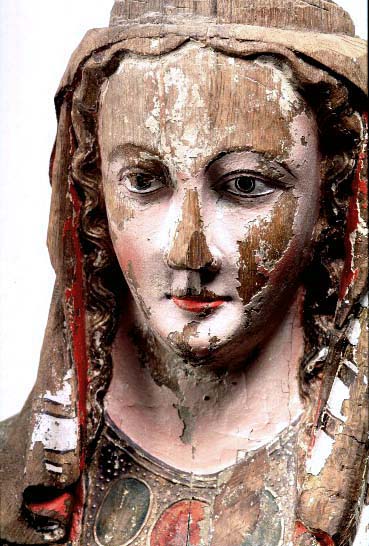
This is the one that made me think of lined veils many years ago, from Vagnhärad in Sweden.

Photo: Lennart Karlsson, Medeltidens Bildvärld

As you can see it is made from a white fabric with gold stripes, and lined with red. It is locally made c 1300.

Then there's the treasure trove that is MS K26 at St.John's College, Cambridge - lots of lined veils there.

The Adoration of the Magi, fol 14r - white veil with red lining.


The burial of Mary, fol 24v - white veil, blue lining


The crucifixion, fol 19v - white veil, red lining.


The death of the Virgin Mary, fol 23 v - white veil, red lining


The descent of the Holy Ghost, fol 22r - white veil, red lining


The entombment of Christ, fol 21r - two green veils with red lining


The sickness of the Virgin Mary fol 23r - white(ish) or pinkish veil, green lining


The Visitation fol 11v - two white veils with red lining