It took over a year, but I have now made a page for my striped 18th century gown. It is here:

After making my 18780s outift I realised that I wanted to trim the robe along the sides, and that I, if I did some piecing, had enough fabric to make a matching petticoat.


I also took some photos with my white broderie anglaise petticoat, and the blue stomacher.


I didn't have the time/energy/inclination, to do my hair properly for these photos - but there will be other times. Now I am going to make the alterations that I need to do to make it easier to get it to fit right.
My sister had decided to celebrate her 45th birthday with an 18th century party. And of course I ws going to go. (Her husband's birthday was celebrated with a 19th century dinner in 2023, you can see my 1830s outfit here)
I got rid of my old 18th century stays, made after Nora Waugh's interpretation of the Diderot drawings from the Encyclopédie, when I lost all that weight six years ago. Which probably was a bad idea, since I gained it all back again. (Link to a good blog post about Diderot's and Nora Waugh's stays)
But in any case I wanted a slightly later type of stays, and decided to do something that I have never done before: not only buy, but actually USE a commercial pattern. I have bought patterns before, but never actually used them ;)
I had heard lots of nice things about Scroop Patterns, and their Augusta stays , and also seen a lot of people making them on Instagram, so I ordered them. This was another first for me too: This is the first pdf-pattern that I have used (mostly because I normally make my own patterns)
And I am so happy with the pattern. I have a weird body: narrow straight shoulders, large boobs, a very wide rib cage that angles out at a 45 degree from under my boobs in front (the combined effect of arthritis and pregnancies), a very non squishable waist thanks to a titanium net covering all of my stomach after a hernia, a long torso and high hips. But the stays fit me without alteration, I think thanks to the clever placing of the boning. To make them more comfortable I chose not to lengthen them, but becauase of that long torso they still look proportional.
Stays, all hand sewn. Because I am insane, and because I was influenced by Myra Lea (link to her Instagram) while having lunch in Stockholm in October.

I am also wearing Scroop Patterns free pattern for a false rump here, and a petticoat that I made from a decorative bedsheet with a wide broderie anglaise flounce that I found at a charity shop.
Actually, everything in this costume except the silk, which was a left over from another project, the pink ribbon, the boning, the fabric for the blue pettitcoat and stomacher, the yellow ribbon and the plumes is bought from charity shops.
The shift is a linen bedsheet, the inner fabric of the stays in hand woven linen fabric, probably intended for towels, and the gown is a rayon satin that probably was made for furniture.
The fabric for the blue petticoat is deadstock fabric from Gårda Textil, a local fabric shop which has a lot of both vintage fabric from their own history, and more newly aquired deadstock fabric. I cannot guess when it is from, it could be any time between the 50s and the 90s.

The trim around the sleeves and neck is probably from the 1940s, and I bought it at a charity shop over twenty years, intending to use it for an 18th century gown. Sometimes things just take time.
The cap was made for my very first 18th century costume in 2007. But it wasn't properly starched and mounted, just gathered with a ribbon. Now it is very much starched, it feels like paper, and luckily survived being carried on public transport a slightly rainy evening.
2007:


I haven't done any serious backcombing since the 1980s, and it was much easier then, with a layered hair cut. My hair is too long all over but the cap hides the not so good looking back of the head where I mostly pinned hair in place.
Then I added powder, both normal powder and some rice flour, because I didn't have enough powder at home. As a first attempt I think it looks good enough.

And it lasted through five hours of dinner party, the cap photos above are taken when I was leaving.
And this is from the tram on my way home. Still raining a little.

The page about my folk costume has now been updated with info about, and photos of, the new bodice, and some new photos of the older pieces.

The new folk costume bodice is finished.


Unfortunately both bodices that I made for my folk costume have shrunk in the closet ;)
This summer I inserted panels at the side of my newest bodice, to be able to wear it for midsummer. But since most of my weight is gained in front this isn't optimal. But it was wearable

I am also wearing a new silk kerchief, and a new reproduction cotton print apron. Both these were found at charity shops. I have also made a new linsey wolsey skirt in green, which is avery popular colour in theprobate inventories from this time and place that I have been working on the last two years.
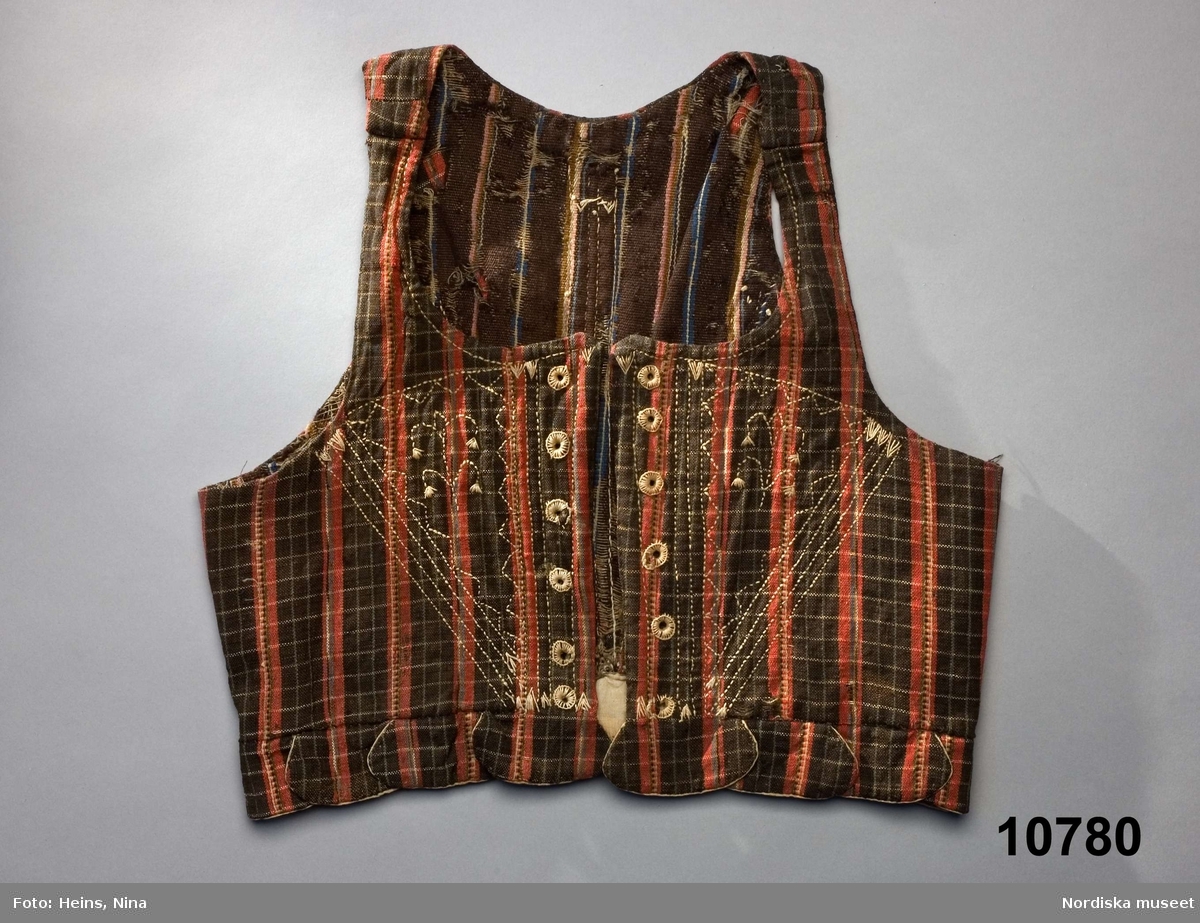
Anyway, while I can wear the dark blue bodice there is no way I can fit into my old checked one. And I like the checked ones better.
The original for my old checked bodice, called "Viste"

.jpg)
When I did my first bodice I mainly enlarged the original. Now I have both changed shape and become better at pattern making, so for the new one I will adapt it more to my large bust. The other one worked, and looked good, but since my weight gain isn't symmetrical it will look better if I add more in the front.
So after my first preliminary mock-up from a sturdy polycotton twill. Then I also made a wearable mock-up, intended to be worn as an example of popular dress in the period, if not part of the actual costume. For this I used a hand woven half linen, and a piece of rust coloured wool twill, both thrifted.
I sewed most of it on machine, though none is visible on either outside or inside now that it is finished.

There are some smaller things that I will change when I make the real thing, but I am happy enough to use it as a pattern for the new bodice.
The "real" one will be made from much stiffer fabric, and have more boning - the embroiderycontaisn boning channels.
The Viste bodice was lined with unbleached linen, but the Åse one is lined with a striped fabric. I am not going to look around for hand woven linen for this, but will use a thrifted striped cotton.
To make the birght colours a little duller I soaked the cotton fabric over night in strong tea. Not as dark as the original, which had black as groudn colour, but good enough for me.

I have cut out the lining now, so that I can place the pieces on the hand wocen fabric on Wednesday when I go to Nossebro and will be able to buy tthe fabric.
Last week hubby and I visited Götheborg of Sweden, the world's only replica of an 18th century Ostindia ship. It was built 20 years ago, as a copy of a ship that sank outside Gothenburg in 1745.
I had for some reason never been to see the ship, and I thought that it would be nice to dress up for it. So I hand sewed a mid-18th century working class outfit. You can read all about it, and get patterns for the cap, on its page.
Here are some photos.


While working on a lecture about my folk costume and the studies I have done of rural manners of dress in that area i realized that I never posted photos of my green frieze (vadmal) skirt and jacket that I made about a year ago. The fabric is from Korps. Jackets and skirts made from green frieze is very common in the probate inventories from the time and period that I have been studying. It is a very strong green, but it is close to preserved frieze skirts from another part of Västergötland, and it was as close as I could get.

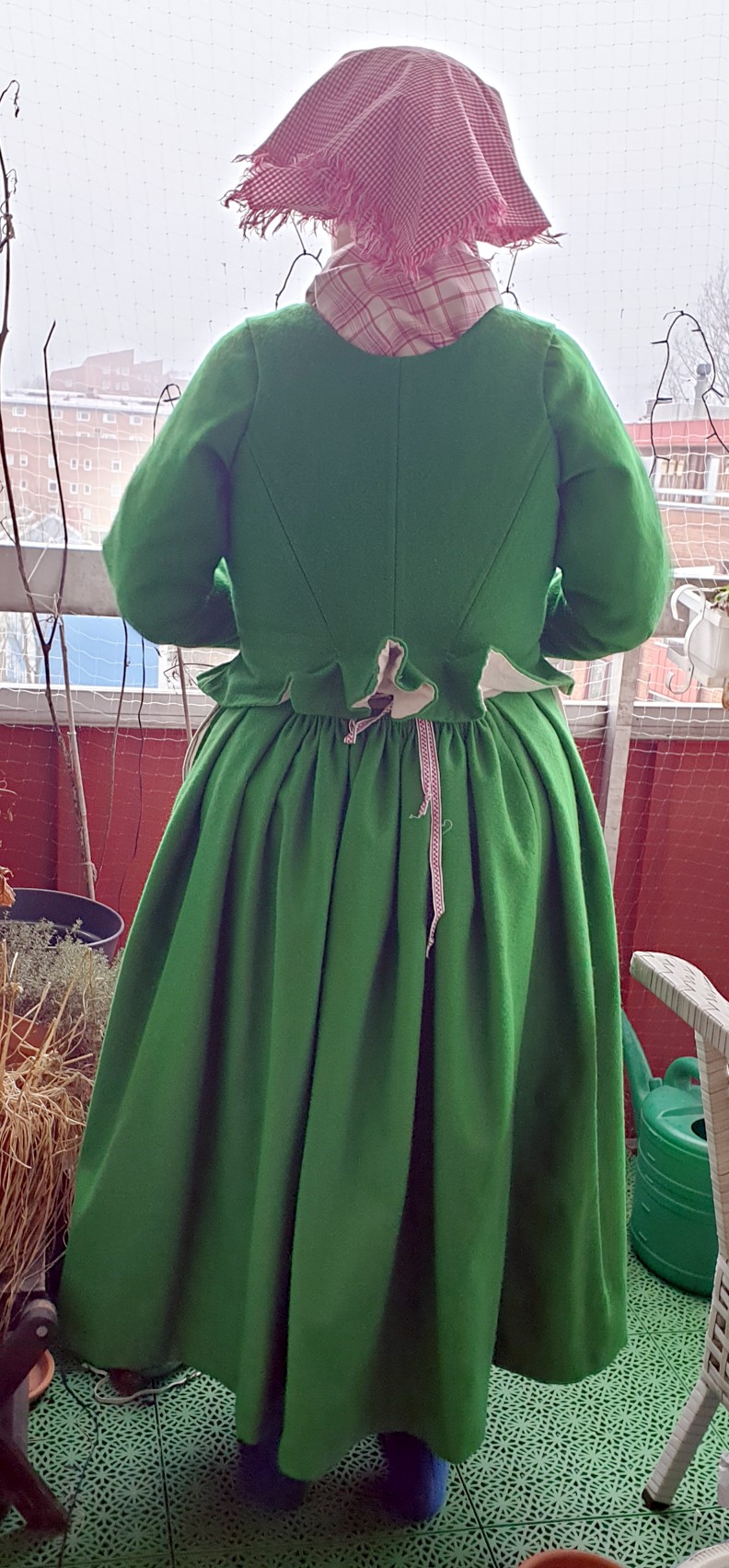
I made the pattern based on several preserved alte 18th century folk jackets, and the skirt is made the same way as my red folk costume skirt. All hand sewn of course.
The jacket is closed with lacing in the lining, and then pinned shut.

The jacket is worn instead of the sleeveless bodice in colder weather. The apron is striped cotton, a thrifted curtain, the head scarf is also thrifted, but the neckerchief is bought from Folkdansringen Göteborg.
At first I thought that I hadn't done much in 2021. Except for hiking, biking, ice skating, swimming, and slowly getting back to working.
But apparently I did quite a lot of stuff, and unusually much for other people.
Last year's summing up was thematic, but this year I will do it by month instead.
January
In January I started on my biggest costuming project this year: what ended up to be not only one, but two Spanish 12th century outfits. Or one and a half. I spent much of the time embroidering on the sleeves on my shift.
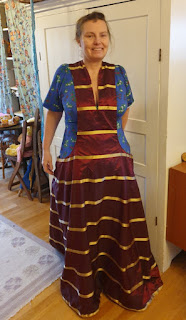
The first part to be made was the surcoat, which is called pellote. All hand sewn, from silk and lined with wool.
February
The embroidered 13th century Spanish shift, which I made slightly supportive by quilting to layers of linen together in over the bust area, and making it tight was finished in February. And it turned out that I shouldn't have bothered: the saya keeps everything in place just fine.


April
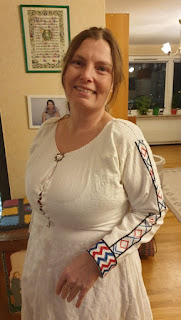
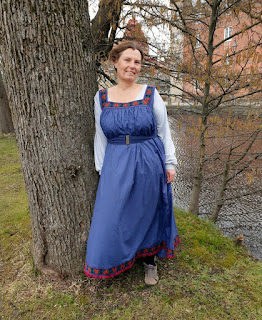
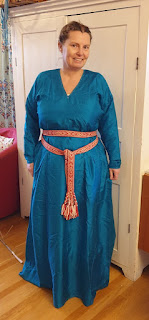
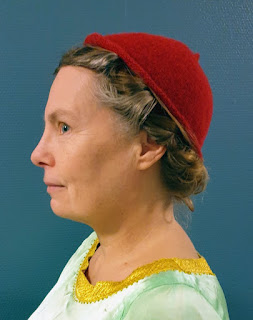
I made a red blouse to wear under the blue reform dress. Here yopu also can see the blet that I made for it with the same trim as on the dress.
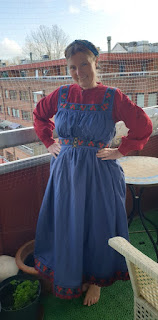


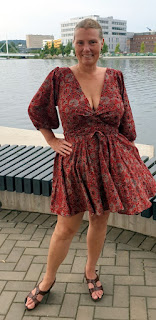




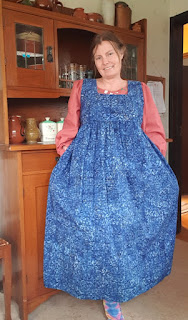
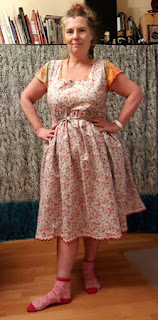
I also made a modern apron dress.
December
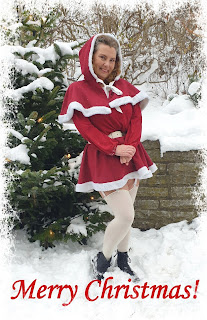
December means making the annual christmas themed photoshoot - and clothing.
The cape and skirt are made from an old 14th century wool gown that I made in 1998, and which doesn't fit me anymore.
I also made a christmas apron from a thrifted curtain, and a wool skirt for my folk costume and a modern apron dress. And knit a new scarf from thrifted yarn.


