söndag 20 maj 2018

I've made the first item in my 1330s outfit from Genoa

So, in March I wrote about this illustration from the Cocharelli Treatise on the Vices.


If you follow the link above you will find some reasoning about the clothes depicted, and further links to other posts that I have written about the weird high waisted gowns of late 13th-early 14th century Italy.

Surprising no-one I decided for an insane striped version, though I plan to make the white version too later, from white cotton muslin I think.

I had to look around for a while to find striped brocade, because I didn't feel much like piecing together two brocades to make stripes. To my great joy I found it at Vedah Designs on Etsy, and promptly bought all of it :) I also got lining tehre, because you don't want to wear unlined brocade with those floating metal threads on the back of the fabric.

The lining is a shot silk mix in bright pink and saffron yellow.


And this is the tunic. 


There is gold trim around the neck, wrists and armscyes, and along the seam on the back of the sleeve.

I have cut out the pieces for the overgown, but haven't started on the sewing yet.


lördag 19 maj 2018

Pimp my Ikea bed

While the more ambitious of us (or those who have access to a wood working shop, or at least don't live in a flat) make their own beds I decided last year when I started making my painted chests (1 and 2) that I wouldn't make my own bed, but instead buy this cheap bed from Ikea. We bought it just before Double wars last year, and have thus used it twice now.

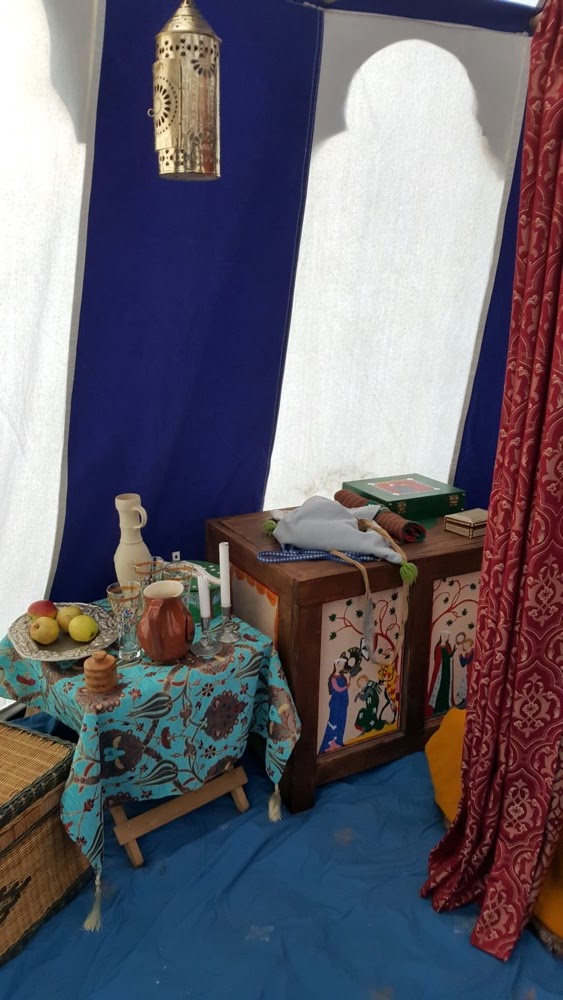
Here are some photos from my pavillion this year:


In the top photo you see the headboard of the bed, and while not glaringly non-medieval I still wanted to make it fit in more with the rest of the furniture, and with period images of beds.
Especially since a lot of people now have bought the same beds.

So glued some 1mm plywood on to two of the bars, making it look like a whole board there, and stained the whole bed with the same paint as the chests. I also painted our devices and some patterns on the "board" of plywood, and added two wooden knobs that I had painted.


I think it will look really nice when we camp next time.

måndag 14 maj 2018

Barbie's 16th century Saxon court gown

At Double Wars 2018 there was a party sponsored by the Ladies of the Rose (former queens in the SCA) and somehow that got me inspired and insane enough to make a 16th century Saxon Court gown which would have suited Barbie. In pink (synthetic) velvet and rayon brocade, both from my stash (the velvet was a gift many years ago).

I was obviously inspired by the paintings of Lucas Cranach the Elder.


The skirt is a full circle. I was really,. really short on fabric, so it got just a little bit shorter than I wanted.


The front edges of the bodice are stiffened with a row of hemp cord. The pink band over the bust is sewn to one side and pinned to the other with two large brass pins. The 

Less Barbie-like, with my hair covered by a net. I need to make another oen if I'm going to wear this gown more seriously. And I probably will, because I look pretty in it and despite being made mostly as a joke and from non-period materials, it is well made, and with no visible machine seams.


torsdag 5 april 2018

Making a 14th century night cap

In only a month the SCA camping season starts with the event Double Wars. And since we are having a very cold spring (due to the record high temperature at the North Pole pressing down cold air further south) I am more than a little worried about keeping warm in my pavillion before hubby joins me after four days.
Asking advice about heating the pavillion (I am leaning towards this) a guy in our local group mentioned that you (obviously) shouldn't keep it running when you are asleep, and that you heat up you pavillion, put on your cap and crawl into your sleeping bag.
Well, I do have a sleeping bag, and lots of modern caps (I'm an enthusiastic knitter), but I thought: wouldn't it be cool with a period night cap?

There are lots (well, relatively) of preserved ones from the late 16th - early 17th century, like this one, from the Cleveland Museum of Art:


But since I mostly make earlier periods I wasn't that interested in making one of those. I am also sure that it wouldn't be comfortable to sleep on the embroidery - they were after all probably mostly worn as undress rather than for sleeping.

But they did use night caps, for instance Les Quinze joies de mariage from the 14th century mentions the wife providing night caps for overnight guests. And there are images, though it took me a few hours of browsing through my vast collection of 14th century Italian images to find a few:

The women here appear to be sleeping in St.Birgitta caps. Which is only reasonable, they're extremely practical.


However, I wanted something warmer, made at least partly from wool, and found these Italian paintings:

Barnardo Daddi:


Memmo di Filippuccino:

The last one is from San Gimignano, and from 1306, which is one of the periods I mostly wear. I find it interesting that sh'es naked except for the cap :) And it shows that women also wore this kind of cap at night.

So I made a night cap from red wool, lined with white linen. The lining is slip stitched in place at the edge and easily removable for washing.


And finally: Some ordinary caps that I thought were intriguing and could be used for night caps too maybe:


onsdag 28 mars 2018

My next (?) project

This may not be my next project, since there's always the possibility that I'll make something quickly for Double Wars for instance. But it is the project that inspires me and fuels my clothing research right now.


This is a leaf from a treatise on vices, owned/comissioned by the Cocharelli family in Genoa c. 1330-1340. This particular leaf is at the Cleveland Museum of Art (link to the manuscript leaf and a high resolution view of the illustration above). A few other pages have been preserved and most of them are at the British Library (link).

The motif is queen Accidia, personifying Melancholy, who can't even be enthusiastic over board games :)
The text at the Cleveleand museum of Art stresses Islamic influences in the textiles, and in the jeweled headdresses of all women except Accidia. They do not mention the dress of the women as specifically ifluenced by Islamic culture, which is wise, since both the type of garments worn together and the way thatthey are decorated are found in many images from late 13th to mid- 14th century Italy.

I have already written about Italian gowns with high waists, belted and with seams (as well as making one of silk and one of cotton).
Blog post 1.
Blog post 2.
Silk gown
Cotton gown

So high waist seams are definitely something seen in Italy at this time.

The placement on the trim of the two non-striped highwaisted gowns is also rather common, here are just a few examples:

The Tolentino basilica


The white gown is also split down in front, as the gowns in the Cocharelli treatise.


While the woman to the right below has a gown that is split at the sides.


I have (of course) also written a blog post about split overgowns in the late 13th- early 14th century, it's here.

The fresco San Zeno in Verona which was the inspiration for my teal silk gown, also has decorations which are similar to the ones in the illustration at the top of this post. And, of course, the high waist seam.


Ambrogio Lorenzettis painting of the bad and good judgement shows a woman in a dress with the same trim placement as on the Cocharelli treatise, almost like a yoke.


St.Ursula, from Chiesa di St. Orsola in i Vigo de Cadore in the Veneto.


As for overgowns split both at the sides and in front (and possibly in the back), as the woman in the mi-parti outfit has, there are examples of this too, like this: Giovanni Baronzio 1325-1350, The Life of St. Columba


As for the headdresses being Islamic inspired I don't know enough about Islamic dress to say anything about it, but one can note that wearing your coronet/crown tilted back is not that uncommon in 14th century Italian art.The added jeweled band seems a little odd though.

This of course needs to be examined further.

But if anything it is queen Accidia that looks... - almost French, rather than Italian.

I haven't yet made up my mind which of the versions that I want to make. The mi-parti one is cool, the white unusual, but the striped ones are more insane, and I tend to go for that.

fredag 23 mars 2018

Close-up of closures in the 15th century

Last week I was in New York - a big adventure, though spent in a very familiar way: museums and a conference. I took no less than 1993 photos, though about half of them are of the signs telling what I actually had photographed.

Since so many art historians (and others) have used the collections of the Metropolitan museum of Art, that most of the paintings are well-known by anyone interested in historical costume. Still, it's nice to have your own photos, and when you're there you can take detail shots of things that interest you - like closures on clothing in the 15th century.

Workshop of Andrea del Verrocchio: Madonna and child, 1470s. Both nice ladder lacing on the bodice and a good view of the ties on the sleeves.


Raffaellino del Garbo 1490s-1500? Detail of sleeve closed with pairs of clasps? Or buttons?Note the stripes on the smock.


Domenico Ghirlandaio 1488, close up of boy's sleeve closures. Look at the fur lining showing and the lovely brocade too.


Davide Ghirlandaio: Selvaggia Sassetti 1487-88 - look at the beatiful little metal "eyes" for lacing.


This one's from the Pierpont Morgan Library and Museum. Nice view of the front opening.


Close-up - you can really see the pleating, the ties,  and the smock under the gown.


And then a Flemish Madonna from the Met, look at the buttons on her sleeve. Master of teh legend of St.Ursula, late 15th century.


More Flemish, Hans Memling: the Annunciation, 1465-75. Nice buttoned sleeve.


söndag 11 mars 2018

And the second painted chest is finished

And tonight, the night before I leave for New York and the Inside Out: Dress and Identity in the Middle Ages  conference at Fordham University, I finished my second clothes chest.

The first one had a variety of courtly couples on it (see it here) For this one I decide to keep to one medieval story, the story of Lancelot and Guinevere.


I want to move one of the hinges about one millimetre, but that will have to wait until I get back.