lördag 12 juni 2021

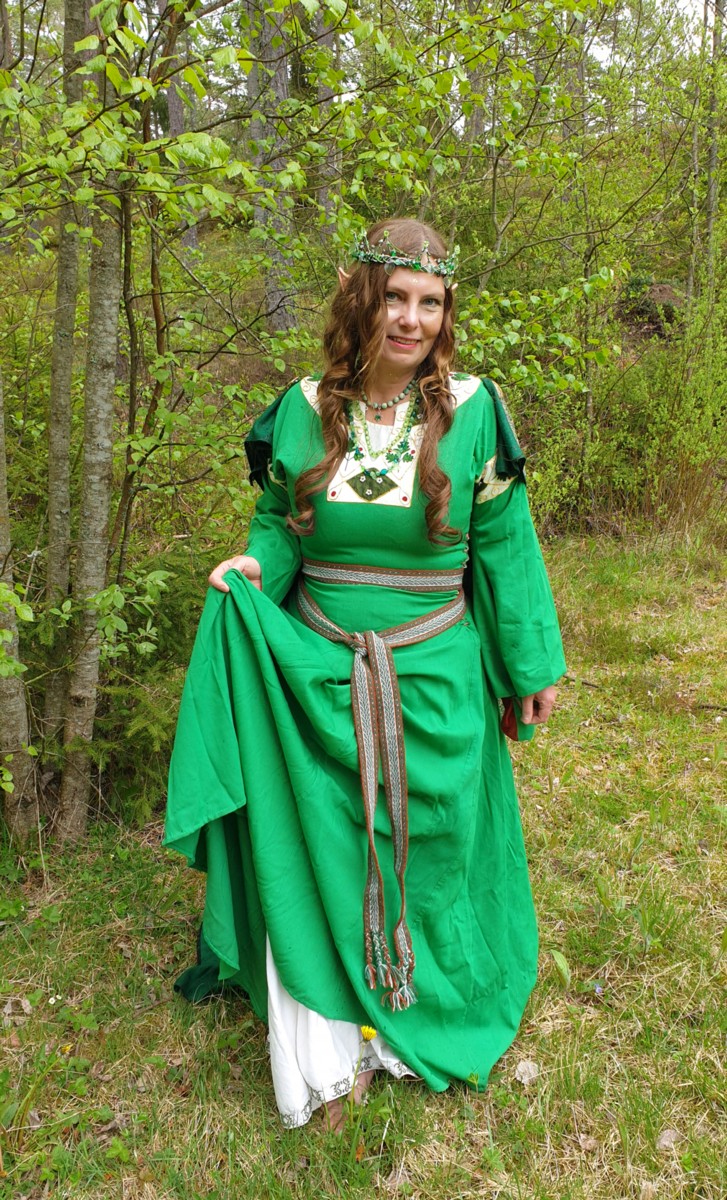
My striped saya encordata is finished

 As you might remember from my January post, this year I took up a project that I really should have both started or finished circa 20 years ago: A 13th century noble Castilian outfit based on both the preserved garments in Museo de Burgos, and on period illuminations, statues and other artwork.

I made the pellote, and I made the embroidered shift, but then I got sidetracked and instead of making the blue silk saya encordata I dediced to try the pattern that I had made on a slightly cheaper fabric. The fact that both the 13th century Spanish people and I were/are crazy about stripes probably contributed to this. And that I have been looking for an excuse to make something from this striped wool from Göteborgs Textil forever.

I have also been experimenting with the weird 13th century Spanish headwear. I have some theories, which also gives answers about how other types of pleated fillets were made in the rest of Europe in this period.  But that will have to wait until I have the energy to write down my documentation properly.

For now you will have to do with some photos of the finished outfit, and some of the inspiration. And yes, I couldn't be bothered to put on proper shoes - but apparently  winding 4 metres of linern with a pleated frill on it around my head wasn't too much work. Yes, I am weird.


torsdag 27 maj 2021

All I need now is an early 19th century ball


I finished this 1810s gown already in December, but then I "had" to make a silk petticoat to wear under it, and I wanted a matching spencer, which I finished ten days ago, and a turban, which I finished last week.

Then I was busy with my fantasy photo shoot, but yesterday Rickard and I got around to taking photos before he had to be at work at noon. The background is my living room, I hope to use this one at a ball some time, to get photos in a proper setting.

Anyway, I did make a page for it, where you will find more info and photos, it is here.


tisdag 25 maj 2021

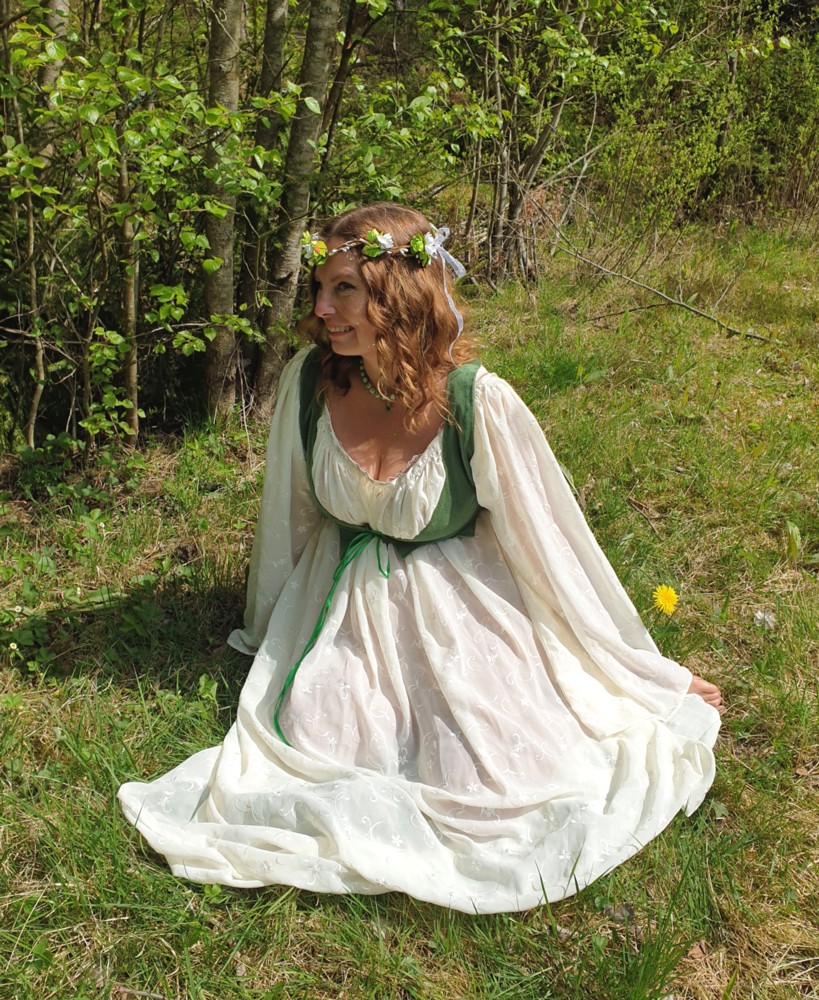
An Earth fairy photo shoot

As part of my project of having a wire crown for each of the four elements, and a photo shoot as a fairy/an elf for each element I brought lots of stuff with me when hubby and I went to a cabin in the woods last weekend (this is where we went, we love that place). It's the same place where we took the Water Elf photos.

When I did my green fairy queen photos last spring I hadn't made the wire crown to go with that element - I only started making wire crowns in July, So I needed more green fairy queen photos. I decided not to have the same clothes, partly because the Venetian gown is a little bit too small now, partly because it's more fun to do something new.

Rickard took photos of me in two different outfits, one is my 12th century wool gown, and the other one was my wedding camicia, made after the 16th century camicia at the Metropolitan Museum, combined with a sleeveless spencer that I intend to wear with my Regency ball gown that I made this winter. There will be photos of this too eventually, I'm just trying to figure out if I can sneak into a house to get a good environment for those photos.

But, that's for later, here are some of my photos, and a video, with my Earth fairy crown.


Yes, I had a hard time choosing ;)

On the porch of our cabin, with my hair  wrapped  around some elastic to keep it curly while I changed to  the next outfit.

Camicia and spencer.


The best pohotos of that outfit was without the crown, however.


tisdag 18 maj 2021

Plague Wars, new 15th century gown etc

So, last week, Thursday to Sunday was Plague Wars, the online substitute for the biggest camping event in Drachenwald (SCA Kingdom covering Europe, Israel and South Africa) and one of the most important things that I do every year. It gives me joy and relaxation, and usually plenty of time to go swimming. Here and here you can see photos from Double Wars 2019.

At was so lovely to see all these lovely people, to hang out in break out rooms for the after court party (I got quite drunk and happy on Saturday).

It als gave me the opportunity to dress up. On Thursday evening I wore a new hand sewn cotton Italian 15th century gamurra.  


I really have the perfect profile of a substantial quattrocento woman. I will write more about the gamurra later, it will get its own page.

I wore the same outfit on Friday, where I first gave a lecture on the regulation of dress for "common" or "loose" women in medieval and early modern Scandinavia, called "No scarlet for bad girls". It was taped, and when it has been edited I will let you know. For my Scandinavian readers: I did write an article about this in 2014, you can find it in this book: Auður Magnúsdóttir, Bagerius, Henric & Hermanson, Lars (red.), Det våras för medeltiden: vänbok till Thomas Lindkvist, Inst för historiska studier, Göteborgs universitet, Göteborg, 2014

I also did hairtaping on non braided hair for the first time in over a decade. Unfortunately my hair isn't as long as I would like it to be for this style.


Then I had organized a small picnic for a few friends in a nearby park.

Lady Alfhild de Foxley in 15th century Northern European clothing. 


Me munching melon


Food


Fru Ingeborg Svantepolksdotter and Fru Jehane Arbonne rocking the 1250-1325 style which I also wear most of the time.


The rest of Friday was spent making a scroll for the blank scroll competition. I hadn't done any work with gold in over a year, sop it wasn't perfect, but good enough to get quite a lot of votes.


On Saturday I hung out with people and sewed on zoom, and made medieval food for the evening.
I also made some of my favourite food that I eat on Double Wars, which isn't medieval as far as I know: bread made in a cast iron skillet wioth butter and wild garlic. There is so much wild garlic at the Double Wars site. 
And this year I got a pallet collar outside our block of flats and there I have, among other things, wild garlic. 
Wearing my Italian c. 1300 cotton gown for cooking, and picking wild garlic.


The dinner that I made was Lasini and fungi di monte, both from a 15th century Italian cookbook.


Then I changed into my mint green mid 14th century Italian outfit for court (and after party).


The most important thing on Saturday court was Master Antonio beign elevated to teh Order of the Defense, but I also got a surprise:


Made by Edward Boreham.

The Orden des Lindquistringes, my first service award outside of my barony.

That was really a great party, so next day when I was biking 5 kilometres (one way) and back to meet some friends I was rather tired. This is my biking outfit, and when I got home I tied up my braids (they don't fit under the bike helmet anyway) and hung out until five minutes before court.


And pulled my silk brocade gown over it, added a veil and put on my coronet.


torsdag 25 mars 2021

A checked muslin dress from the 1810s

The gown has been finished for a couple of weeks, and the chemisette for abotu a week, and today I had the energy to get dressed and take photos with my phone and a tripod outside a local manor house from the 1840s.
It was cold and overcast, with some drops of rain too, so the curls that I had worked on just disappeared. But I really like the photos. The house is an office now, but because of the pandemic there didn't seem to be anyone there, which of course is just as well when you're taking photos of yourself in funny clothes just outside their house.


Here is a page about it, with more photos and info, some inspiration fashion plates etc.

onsdag 17 februari 2021

I DID skate more - 17th century Dutch version

Ever since I saw the Dutch 17th century paintings of people skating some 20 years ago, I have wanted to make one of those outfits. I have made a collection of historical Dutch ice skating pictures over at the web site of the Rijksmuseum, not all of them 17th century though.

But it is only the last years that I have allowed myself to make clothing from eras where I have nowhere to wear them, and then there was the need for proper ice :) We don't usually get these winters in Gothenburg.

Miraculously the cold came back after a short thaw with snowfall, and I have enjoyed over two weeks of skating on various ponds and bogs. The one that I skated on in my Regency outfit never got good ice again, but there is a bog with open water in the middle in a nearby nature reserve (2,5 kilometres walking from where I live) where people have cleared away the snow for skating. 

So I decided to make a wool doublet to go with my linsey-wolsew kirtle that I made  this summer. I had already planned to make one from silk damask for Gothenburg's 400 anniversary this year, but that celebration has of course been postponed due to the pandemic. The nice weather however put a fire under me, and I decided to make a wool doublet to wear for some skating photos.

It is now warmer again, around or just below zero and it snows quite a lot, so I am happy that hubby had the time and energy to go with me last Saturday to take photos of me skating in my early 17th century clothes.

And that I managed to make the jacket, and the weird starched hat. 

Most of the women in the Dutch ice skating paintings which were my inspiration wear a black gown, hitched up, over a kirtle, usually with applied stripes on the skirt, like mine.

Hendrick Avercamp, c. 1620:


I did actually have enough of the fulled cloth for a gown, but it is way too heavy and bulky to be hitched up. So I settled for a doublet. This is also more useful for me, since it is something that is often seen in Scandinavian early 17th century pictures, and I can wear it whenever we will celebrate the anniversary.
Lower class women are seen in jackets on Avercamp's and other's paintings, usually in some kind of regional costume, but my costume is more an affluent burgher's style, so let's call it a compromise. And it is not uncommon with doublets on Dutch women in the early 17th century, just not when they're skating.

This was a stash busting project. The doublet is hand sewn from fulled wool cloth that my mum bought 23 years ago, lined with linen fabric I got from a friend after he cleared out his stash from stuff he hadn't used in over 15 years, the buttons are thread (I used perle cotton, because it covers better than the silk buttonhole twist that I had at home) over wooden beads that I bought to make buttons for this outfit from 2007. They didn't turn out right then, but the ones that I made now I am quite happy with. 


The twisted cord is viscose, and I got it for the loose kirtle shown here, which is from 2004.

The "hat" is a combination of an undercap that I already had, and a new wired and startched creation. I need to do some changes on that, but it was thrown together in the morning before we went out to take the photos. With the anticpated hange in weather I was in a hurry to get this done. That is also why I am wearing a 20 year old ruff, that really isn't right, but was the biggest that I had.

And yes, I know that I should have a very different type of skates.

This is not how the ladies are generally depicted skating in those Dutch ice skating paintings.


This is more like it, more sedate.

And this.


Nice back view.


tisdag 26 januari 2021

Embroidering 13th century sleeves

 As you can see on the images I shared in this post many of the ladies in the images have decorated sleeves on their shifts. And soemtimed on the body of the shift too. Like this:

I thought about weaving trim, but I think that embroidery is a more likely technique for this. Especially since there is decoration on the chest too.


This is a small scale illustration, so any pattern would probably be very stylized, but I still used this painting as inspiration for my embroidery.


As you may see from the not yet finished sleeve to the left I use a type of Aida where the threads are glued together with a water soluble glue. After embroidering you put the fabric in water and dry it, you can then pull out the guiding threads. Not even before old age started affect my eyes did I have very good eyesight, so I can't really do counted embroidery on linen without help.

The embroidery threads are cotton. Silk, or even wool, would probably have been the period choice, since they take dyes so much better than vegetable fibres, especially linen. But cotton is actually not htat hard to dye, and cotton was both grown and woven in Spain in teh 13th century, so I could make some kind of argument for using it. But it's really because I already had the yarn, from thrift stores, and because I want to be able to wash my underwarm in hot water.

The embroidery is extremely simple brick stitching, since I saw it used on some 13th century German textiles when I was looking around for period embroidery stitches.

Now I need to finish the next sleeve embroidery.