söndag 6 mars 2016

New outfits and a baronial investiture

So, as is probably clear by now, I "play" in the Society for Creative Anachronism. And in a moment of madness/enthusiasm my friend Måns and I decided to enter the baronial polling of Gotvik, where we live. And we ended up being both chosen and accepted by the King and Queen, which meant that much sewing took place.

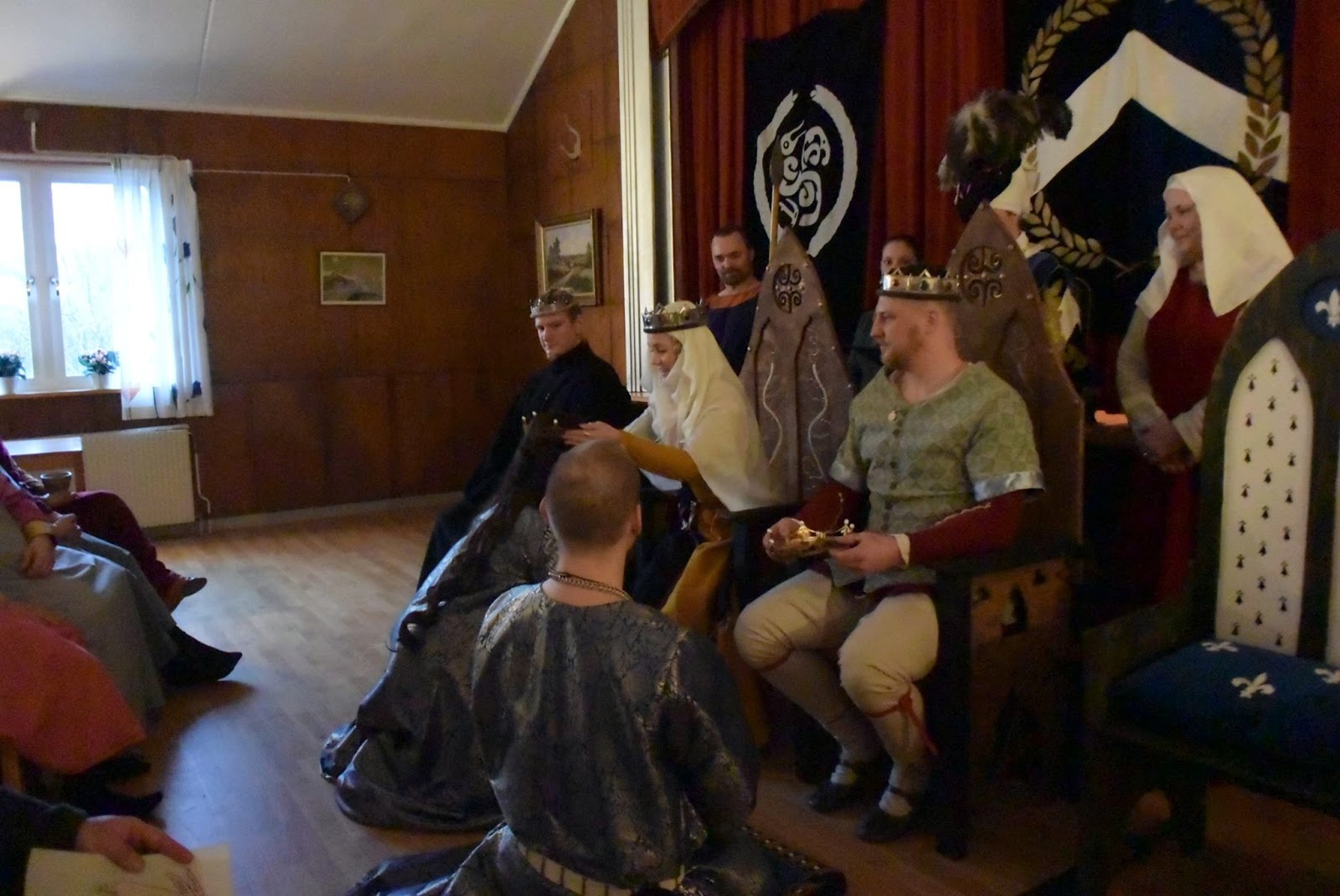
We decided to go in for the period c 1250-1330, which we both like a lot. I made a page on our outfits here, with more photos, where you see the clothes better, and info on construction etc. But here are some photos from the ceremony taken by my friend Alfhild de Foxley.

We swear on the baronial coronets.


The Princess of Nordmark puts the coronet on my head.


As the reprecentative of the lands of Gotvik I then choose my baron and place the crown on his head (yes, we like courtly romances).


Ongoing embroidery

This weekend was St. Egon's Feast and Baronial Investiture (I will get back to that in a later post, since I am now the baroness) and I had some time to work on my embroidered cotte while hanging with my friends.

Photo by Alfhild de Foxley

And now only three fleur de lis remains to be made. Then I'm going to make small lozenges inbetween the lilies and then (after I've hemmed it) a row of stitching around the neck.


måndag 22 februari 2016

Embroidery craziness begun

As you may recall I got enthusiastic about patterned 13th century clothes a month ago. One of my absolute favourites was this image:


End of the 13th century 
France Lausanne, Bibliothèque Cantonale et Universitaire 
U 964 - Biblia Porta fol. 240r

While it is likely that most of the striped garments of the 13th century had woven stripes I thought that maybe, just maybe, when there was just one stripe, or a few, but placed at uneven intervals, as on the man's tunic, they might be embroidered. Or applied from another fabric, but I'm going with the embroidery theory here ;) Since her stripe has the same background colour as the rest of the gown.

So, I have started the embrodiery. In chain stitch, which isn't typical of the period, but my split stitch doesn't produce half as nice results.


There will two double stripes like this, maybe 10-12 cm apart, and then something inside that, haven't made up my mind yet. But fleur-de-lys are always nice. Like Edward the Confessor. Whose tunic surely is made from patterned silk.


Edward the Confessor, from "Life of Edward the Confessor" 

I am also justifying the embroidery with the fact that embroidery on wool was rather common for interior decoration. Imitiating the patterns of brocaded silks in a cheaper technique is at least palusible, especially since we know that brocades were imitated in other ways, such as printing. Though probably mostly for interior decaration purposes, since the paint would have made the fabric stiff. The preserved printed fabrics are either on linen or silk (or printed cottons from India, but I'm talking about European production here), I have not seen printed wool fabrics mentioned before the 18th cnetury, but I would love if anyone of you have found it somewhere earlier - it really isn't my area of expertise.

Also, since we know of embroidered bands at the hem, it wouldn't be so far fetched to make one a bit higher up.

But, as as said before, most were undoubtly woven, in the first link above you find several preserved examples, and there are also lots of documents from medieval Flanders dealing with the production of striped cloth.

A new pink veil

I wanted a pink veil already when I last time got immersed in the fashions of the period 1250-1325. Here's one from the Grosse Heidelberger Liederhandschrift.


I actually thought that I had made one, but apparently not. So today I bought some pink silk, cut and started hemming; while listening to Harry Potter on audio book. And here it is.


It is an oval shape, to give the nice wavy folds you see on so many images in the Grosse Heidelberger Liederhandschrift. Like this one, where you also find the same combination of veil and gold garland as I'm wearing.


tisdag 16 februari 2016

Buying shiny stuff

Finding fitting and jewellery for the 13th and early 14th century isn't as easy as if you're looking for later 14th, or 15th century stuff. There are two reasons for this: one is that there appear to be more finds from this period, or at least more that are dated to those periods. Also, dating tend to be just "14th century", which isn't much use if you're looking for the first 25 years of that century. The other reason is that since there are so many more re-enactors doing late 14t and 15th cnetury there is a much bigger market for it.

Frustratingly a lot of manufacturers also tend to just give the dating as "medieval", and even when they have dating it is usually not possible to do a search by century.

But then you have the web site of Armour&Castings in the Ukraine where you can search by century, and which has a lot of things from my period that I have never seen reproduced before.

Today, which was a seriously lousy day, a package from the arrived and made my day much better. It contained a buckle, some belt ornaments and this lovely brooch:


The funny thing is that I only found the original a month ago or so, here it is: Walter's Art Museum. It's from the 13th century and the letters form a prayer, namely  "AGLA: Atha Gebri Leilan Adonai" ("Thou art mighty forever, O Lord"), I am of course totally ignoring this and pretend that the A is for Aleydis, the name that I use in the Society for Creative Anachronism :)

Anyway, I found it (on Pinterest of course), and exclaimed on facebook: "I want this!" And, two weeks later I found Armour&Castings while trawling the internet, and they had it. I've never seen it anywhere else.

And today it came! So yay!

And when I have money again I am so getting this belt mount.  And lots of other stuff.

torsdag 4 februari 2016

Par vestimentorum de moreto - a set of 13th century clothes in murrey wool

So, I dragged hubby out to take some photos of me in my murrey set of clothes, so now they have their own page.


If you want to read more about matching sets of clothes, I wrote about it here and here.

söndag 31 januari 2016

Waiting for bezants

Bezants, that is metal ornaments attached to clothing (or other stuff)  were popular in the Middle Ages and the 13th and early 14th centuries are no exception. Ever since reading about clothes decorated all over with bezants or spangles in the High Middle Ages, ten years ago or so, I've wanted to made a gown with metal ornaments all over.

Well, someday it would happen. This is the gown waiting to be decorated (and lined, after all the bezants are in place). It's from fairly thick wool and has, as you can see wide 7/8 sleeves, showing that I will wear a cotte with tight sleeves under it.


Since I don't have the money to custom order anything, nor the skill or equipment to make my own bezants I ordered these charms to use.


The heraldic arms that I use in the SCA have white cinquefoils on a green background so I thought that it would be fitting. Since they only have one loop to sew through they will move when I do. This was probably not the most common in period, since all preserved examples that I have seen which are still attached to fabric are attached firmly at several points. There are however many examples of leaves, and other shapes hanging loosely from bezants, and from clasps and pins, so I feel that fluttering floweres aren't that far away from period practice.

I intend to place them in groups of three. While I'm sure that the popularity of this grouping of dots in manuscripts from the period more reflects a pretty way to make patterns than actual garments depcited, the fact that it was so common ought to also reflect a period sense of what was pretty.

However, since they are on their way to me from China just now I can't do more than sew the gown and its cream thin wool lining, which I have done, and collect period images of bezants.

So, here are some:

Finds from London 1300-1500. Note the hanging leaves.


From Bildindex.de, that somewhat hard to navigate treasure trove, there are several images to be found.


Bezants with loosely hanging leaves, same garment


Quite a few five-petaled flowers there too: